
Enterprise Web Software Development: Architecture Decisions That Separate Scalable Systems from Costly Rewrites
April 7
Published

Nazar Verhun
CEO & Lead Designer at MyPlanet Design

Enterprise web software development demands architecture choices that scale. Learn the patterns, stacks, and pitfalls behind systems serving 100K+ users da
IBM’s 2024 Cost of a Data Breach report pegged the average breach cost at $4.88 million — but here’s a number that doesn’t make the headlines: the average enterprise spends between $1.5M and $3M rewriting software that was “good enough” just three years earlier (IBM Security). That rewrite cost isn’t a technology problem. It’s an architecture decision problem that compounded quietly while everyone was shipping features.
Enterprise web software development fails most often not from choosing the wrong framework, but from choosing the right framework at the wrong organizational stage. We’ve watched teams adopt microservices at 15 engineers because a FAANG blog post made it sound inevitable — then burn six months untangling deployment pipelines they didn’t need yet. The inverse is equally painful: monoliths that served well at Series A become the single point of organizational friction at 200 engineers, where every deploy is a cross-team negotiation.
The architecture decisions that actually matter aren’t about languages or cloud providers. They’re engineering economics decisions — tradeoffs between upfront investment and compounding operational cost, measured against team size, compliance surface, and the rate at which your domain model is still shifting. A 12-person fintech team facing PSD2 compliance has fundamentally different constraints than a 200-person logistics platform optimizing for throughput.
What separates systems that scale from systems that get rewritten is when each decision gets made, not what gets decided.
Key Takeaways:
– Architecture quality degrades not from bad choices, but from right choices made at the wrong company stage — reassess at every major scaling inflection.
– Microservices before ~40 engineers typically increases operational cost faster than it reduces coupling.
– Compliance requirements (GDPR, PSD2, HIPAA) should constrain your architecture options early, not get bolted on after launch.
– The 2026 TechEmpower benchmarks show that runtime performance differences between major frameworks matter far less than your data access patterns and caching strategy.
– Treat every architecture decision as an investment with a payback period — if the payback horizon exceeds your next funding milestone, it’s the wrong bet.
What Separates Enterprise Web Software Development from Standard Web Projects?
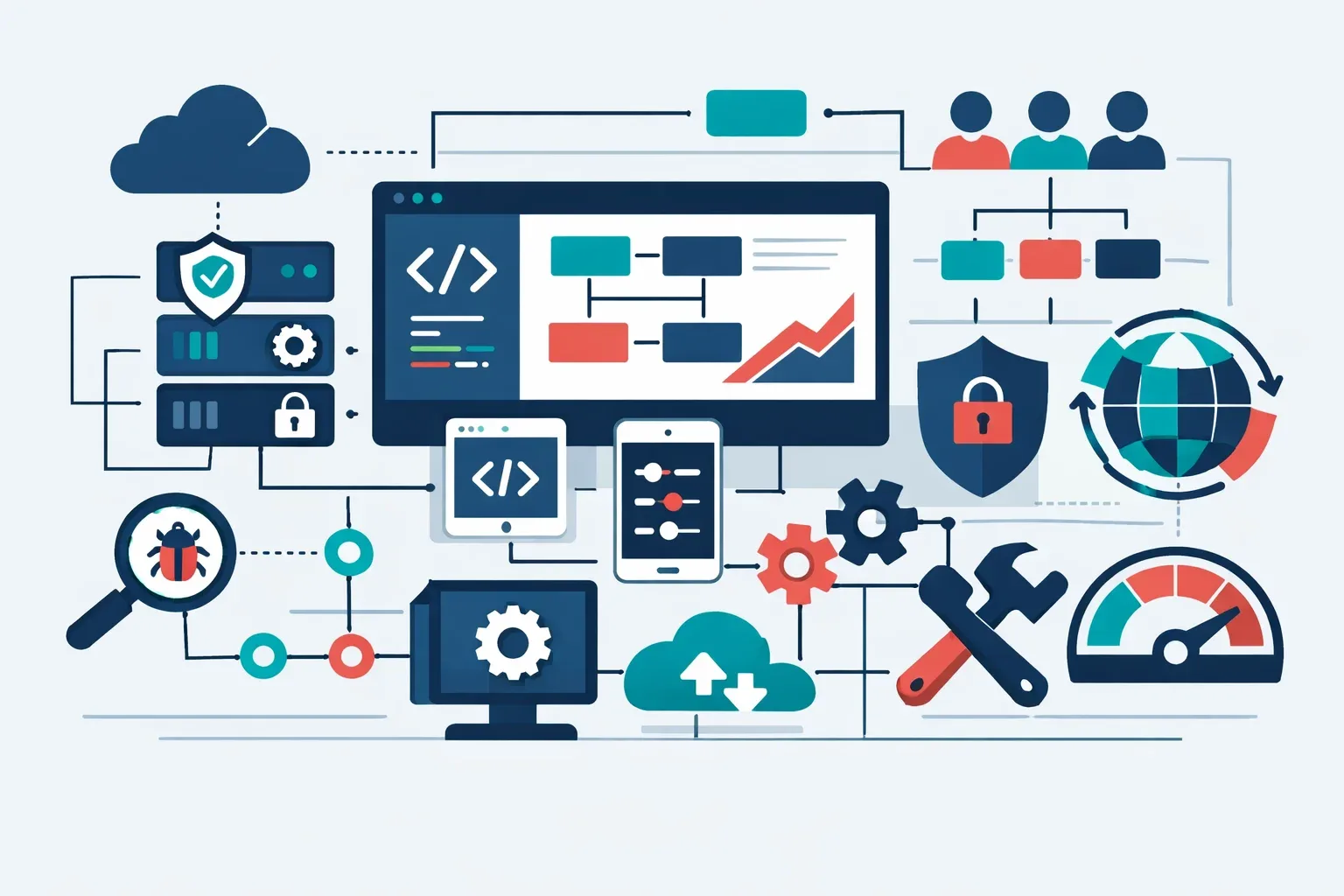
Enterprise web software development diverges from standard web projects at a specific threshold — and it’s not about traffic volume or feature count. It’s about coordination complexity, compliance surface area, and the contractual obligations your software must honor before a single user logs in.
The Breaking Point Is Measurable
Stripe’s engineering team documented what happens when a codebase crosses 50+ microservices: deployment coordination becomes a full-time job, and a single breaking change can cascade across dozens of dependent services. Below 20 developers, a well-structured monolith handles most workloads elegantly. Past that number, every architectural shortcut — shared databases, synchronous inter-service calls, hardcoded tenant logic — starts extracting compound interest.
That’s the inflection point. Not a theoretical one. A measurable, predictable fracture line.
Five Non-Negotiable Requirements
Standard web applications can ship without these. Enterprise systems cannot:
-
Multi-tenancy — Salesforce rebuilt their entire data isolation layer in 2019 when enterprise customers demanded stricter tenant boundaries. Shared-database multi-tenancy works until a Fortune 500 prospect’s security team reviews your architecture.
-
Role-based access control (RBAC) — Not “admin vs. user.” Enterprise RBAC means hierarchical permissions across business units, delegated administration, and audit-ready access logs. Workday’s permission model spans thousands of configurable security groups per tenant.
-
Audit logging — Every state change, every access event, every failed authentication attempt — timestamped and immutable. SOC 2 Type II auditors don’t accept “we can add that later.”
-
SLA-backed uptime — A 99.9% SLA means 8.7 hours of permitted downtime per year. Contractual penalties make this an engineering economics problem, not a DevOps aspiration.
-
Regulatory compliance — HIPAA for healthcare SaaS (think Epic’s Hyperdrive platform), PSD2 for FinTech payment processors, GDPR across any DACH-market product. Each regulation imposes specific architectural constraints on data residency, encryption at rest, and right-to-deletion workflows.
| Dimension | Standard Web Application | Enterprise Web Platform |
|---|---|---|
| Authentication | OAuth 2.0, social login | SSO/SAML, MFA, SCIM provisioning |
| Data isolation | Shared database, app-level filtering | Schema-per-tenant or database-per-tenant |
| Compliance scope | GDPR cookie consent | HIPAA, PSD2, SOC 2, ISO 27001 |
| Deployment cadence | Continuous deployment | Change advisory board, staged rollouts |
| Uptime expectations | Best effort | Contractual SLA with financial penalties |
The Monolith-to-Platform Inflection Point
One pattern we see repeatedly across enterprise engagements: a company builds a successful product on MVP architecture, lands its first enterprise customer, and then discovers that “just adding RBAC” means rearchitecting the authorization layer, the API gateway, the session management, and the data model. What was scoped as a two-sprint feature becomes a six-month platform migration.
McKinsey’s 2024 analysis found that technical debt consumes 20–40% of enterprise IT budgets before new feature work even begins (McKinsey Digital). The companies that hit this wall hardest are the ones who treated architecture as a one-time decision rather than an evolving constraint system.
A mid-market logistics SaaS client we worked with learned this firsthand. Their Django monolith served 200 customers well — until a tier-one automotive manufacturer required dedicated data residency in Frankfurt, SAML-based SSO, and a 99.95% SLA. The migration to a multi-tenant, multi-region architecture took nine months and cost roughly 3x what building it correctly from the start would have. Not because Django was wrong. Because the original architecture never accounted for these requirements as first-class constraints.
The real question isn’t whether your architecture will need to evolve. It’s whether you’re making decisions about your software development approach with that evolution priced in — or whether you’re optimizing for next quarter’s demo while quietly accumulating six-figure migration debt.
Understanding the principles behind scalable digital product design early doesn’t slow teams down. It prevents the kind of rearchitecture programs that consume entire engineering quarters.
How Do You Choose the Right Tech Stack for Enterprise Web Applications?
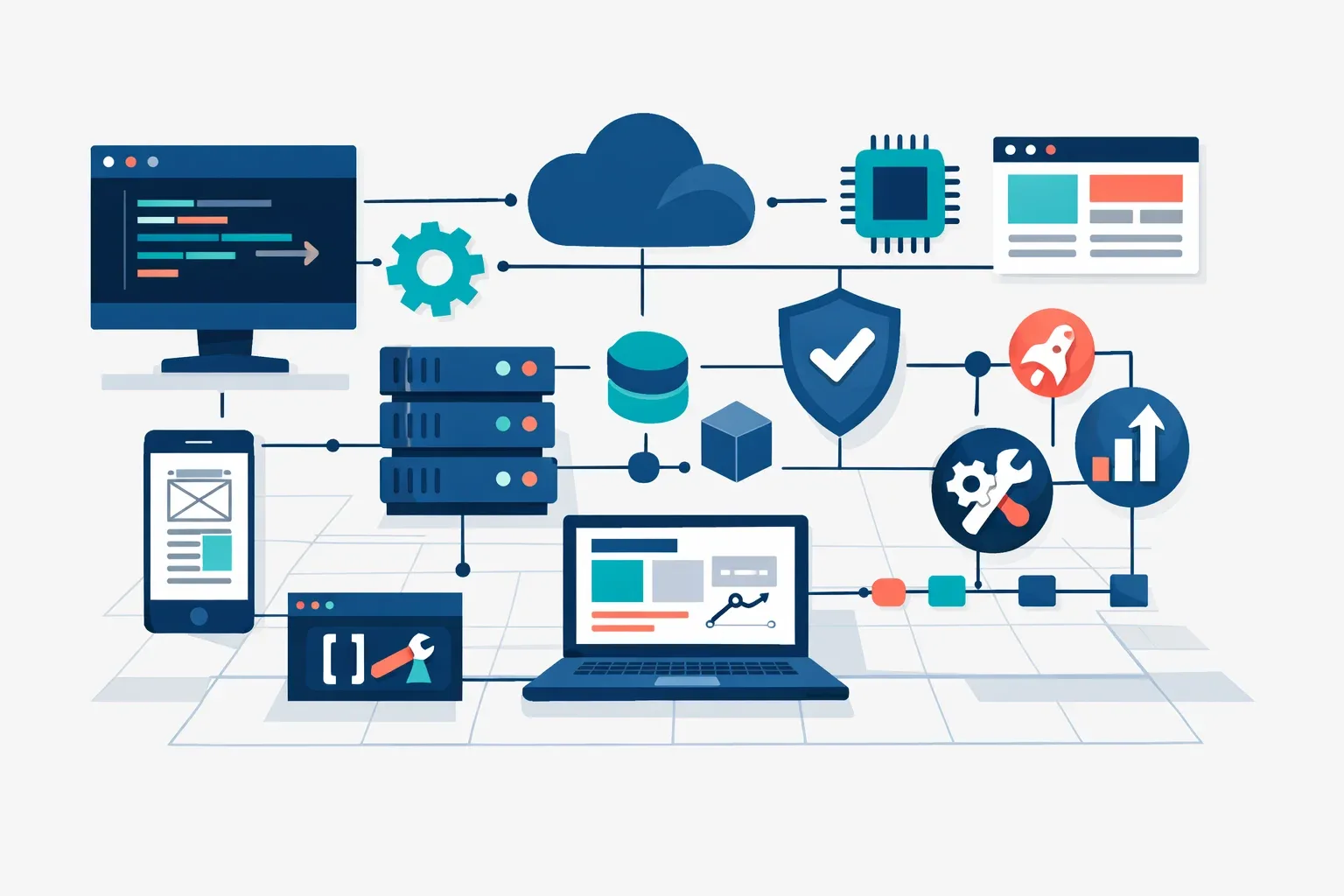
The right tech stack for enterprise web software development isn’t the one your senior engineers prefer — it’s the one that will still have security patches, hiring pipelines, and compliance tooling five years from now. That distinction costs companies millions when they get it wrong.
Backend Stacks: The Five Contenders
Every enterprise backend decision should be evaluated against four non-negotiable criteria: developer availability in your hiring market, long-term support (LTS) guarantees, security patch cadence, and raw throughput under concurrent load. Here’s how the five dominant stacks compare based on TechEmpower Round 23 benchmarks and Stack Overflow’s 2025 Developer Survey regional data:
| Criteria | Node.js / NestJS | Java / Spring Boot | .NET 8 | Python / Django | Go |
|---|---|---|---|---|---|
| DACH developer availability | High | Very High | High | Moderate | Low–Moderate |
| LTS cycle length | ~18 months (Node LTS) | 5+ years (Spring Boot 3.x) | 3 years (.NET LTS) | ~2 years (Django LTS) | ~1 year (Go releases) |
| Security patch cadence | Frequent, npm ecosystem risk | Mature, quarterly patches | Monthly via Microsoft | Moderate, PyPI variability | Fast, small attack surface |
| TechEmpower JSON throughput | Mid-tier | High | Very High | Low | Very High |
Java and .NET dominate enterprise adoption for a reason: their LTS windows align with the multi-year procurement and audit cycles large organizations actually operate under. Go delivers exceptional performance but has a thinner DACH hiring pool — a real constraint when you’re staffing a 15-person team in Munich or Zurich.
One pattern we see repeatedly is CTOs picking a stack based on benchmark numbers alone. Performance matters, but it’s rarely the bottleneck. Developer availability and ecosystem maturity are what determine whether you ship on schedule or scramble to hire contractors at 2x market rate.
The FinTech Rewrite That Nobody Planned
A mid-stage FinTech client chose a newer Rust-based backend framework in early 2024 — fast, memory-safe, technically impressive. Nine months later, they needed SOC 2 Type II compliance. The audit tooling, SAST integrations, and vulnerability scanning pipelines they required simply didn’t exist for that ecosystem. Mature options like Spring Boot and .NET had years of Snyk, SonarQube, and Veracode integration baked in. The client spent nine months rewriting core services into Spring Boot — not because Rust was bad technology, but because the compliance ecosystem hadn’t caught up. The rewrite cost roughly €400K in engineering time and delayed their Series B fundraising by a quarter.
The lesson? For enterprise web software development, “mature” isn’t a synonym for “boring.” It’s a synonym for “auditable.”
Front-End Frameworks: React vs. Angular vs. Vue
ThoughtWorks’ 2025 Technology Radar keeps React in the “Adopt” ring, Angular in “Trial” for new projects, and Vue in “Assess” for enterprise contexts. The Fortune 500 usage tells a similar story: Meta and Airbnb run React at massive scale. Google and Deutsche Bank rely on Angular for internal tooling with strict typing requirements. Alibaba and GitLab have built significant Vue frontends, though Vue’s enterprise adoption in regulated industries remains thinner.
For teams evaluating front-end architecture for web applications, the decision matrix isn’t about which framework renders faster — it’s about which framework has the deepest pool of enterprise-grade component libraries, accessibility compliance tooling, and long-term maintainer commitment.
Angular’s opinionated structure reduces architectural drift across large teams. React’s ecosystem breadth means you’ll almost always find a battle-tested library for whatever edge case you hit. Vue offers the gentlest learning curve but carries the highest risk of “you’re on your own” when you need an enterprise SSO library or WCAG 2.2 AA audit toolkit.
What Actually Drives the Decision
Stack selection at the enterprise tier is fundamentally a design and engineering tradeoff — not a developer preference poll. The constraints that matter aren’t in the documentation; they’re in your compliance requirements, your regional hiring market, and how long your vendor contracts actually last. Choose for the organization’s five-year trajectory, not this quarter’s sprint velocity.
Architecture Patterns That Scale: Monolith, Microservices, and the Middle Ground
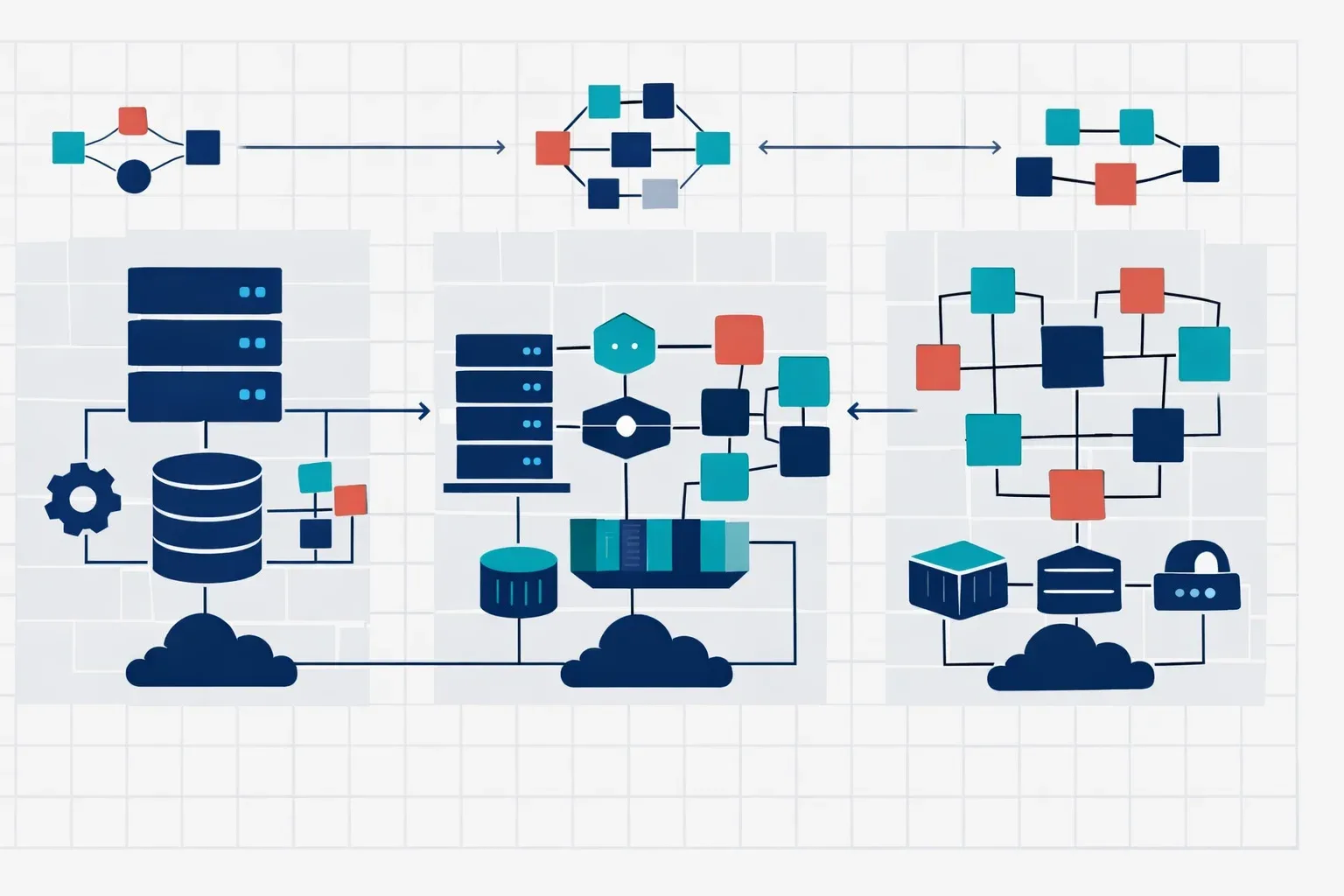
The right architecture pattern for enterprise web software development maps directly to your engineering team’s size and coordination capacity — not your ambitions. Martin Fowler’s MonolithFirst principle holds: premature decomposition creates distributed complexity you can’t debug, can’t hire for, and can’t afford.
Match the Pattern to the Stage
| Company Stage | Team Size | Recommended Pattern | Key Tooling |
|---|---|---|---|
| Series A–B | Under 15 engineers | Modular monolith | Nx monorepo (22K+ GitHub stars), clear module boundaries |
| Growth / Scale-up | 50–200 engineers | Service-oriented architecture | Kong API Gateway (40K+ stars), Istio service mesh |
| Enterprise at scale | 200+ engineers | Event-driven microservices | Apache Kafka (29K+ stars), RabbitMQ for lighter workloads |
Sam Newman’s decomposition criteria from Building Microservices remains the clearest litmus test in 2026: if you can’t define a service’s bounded context in one sentence, it’s not a service — it’s a distributed mess.
When the Monolith Actually Breaks
We worked with an automotive logistics company processing 500K daily transactions on a monolithic Java application. Their pain wasn’t performance — it was deployment frequency. Every release required a full regression cycle, limiting them to monthly deploys.
After migrating to an event-driven architecture with Kafka as the backbone, they went from monthly to daily deployments. Incident response time dropped 63%. But the migration took 14 months, not the six they’d budgeted. The lesson? Budget for the transition tax. Every architecture migration costs roughly 2x what the technical plan estimates because organizational rewiring — team topology changes, on-call rotations, observability tooling — moves slower than code.
The modular monolith isn’t a consolation prize. For teams under 50 engineers, it’s the economically rational choice. Strong product design methodology ensures your module boundaries reflect real user workflows, not arbitrary technical splits. And when you eventually decompose, those boundaries become your service contracts — making the architecture conversation inseparable from how you approach custom software projects.
Don’t migrate because a conference talk convinced you. Migrate when your deploy pipeline proves you must.

Security, Compliance, and Observability: The Enterprise Triad Nobody Budgets For

Security, compliance, and observability are the three line items most enterprise web software development projects underfund — and the three that generate the largest unplanned costs post-launch. IBM’s 2025 Cost of a Data Breach report found that organizations with shift-left security practices (DevSecOps adopted across the SDLC) reduced breach costs by $1.68 million on average compared to those without (IBM Security). That’s not a rounding error. That’s headcount.
Compliance Isn’t One Checkbox — It’s Three Different Engineering Jobs
Each framework demands specific engineering work, not vague policy documents:
- SOC 2 (SaaS): Encrypted-at-rest audit logs with tamper-proof retention, role-based access controls with quarterly access reviews, and automated evidence collection for annual audits.
- GDPR/DSGVO (DACH-market apps): Data residency controls ensuring EU storage, consent management APIs with granular opt-in/opt-out per processing purpose, and automated data subject access request (DSAR) pipelines that complete within the 30-day legal window.
- HIPAA (health tech): End-to-end encryption for PHI in transit and at rest, audit trails on every data access event, and BAA-compliant infrastructure configurations — which rules out most default cloud setups.
A mid-market healthcare client we worked with in 2025 assumed their cloud provider’s default encryption satisfied HIPAA. It didn’t. Retrofitting compliant audit logging and access controls cost them four months and roughly €280K — work that would’ve taken three weeks if scoped during architecture planning.
The Three-Layer Observability Stack
| Observability Layer | Recommended Tool | What It Catches |
|---|---|---|
| Distributed tracing | OpenTelemetry | Cross-service latency bottlenecks, failed request chains |
| Metrics & alerting | Grafana + Prometheus | Resource saturation, SLA breaches, capacity trends |
| Error tracking | Sentry | Unhandled exceptions, regression detection per deploy |
Startups can survive with Sentry alone. Enterprises can’t — because when a checkout flow fails across three services in production, error tracking tells you what broke, but tracing tells you why. Observability patterns also differ significantly across platforms; our guide on enterprise mobile app development covers the mobile-specific instrumentation gaps most teams miss.
If you’re building custom software for regulated industries, budget 15–20% of your initial architecture sprint for security and compliance scaffolding. Bolting it on later always costs more.
What Does a Realistic Enterprise Web Development Roadmap Look Like?
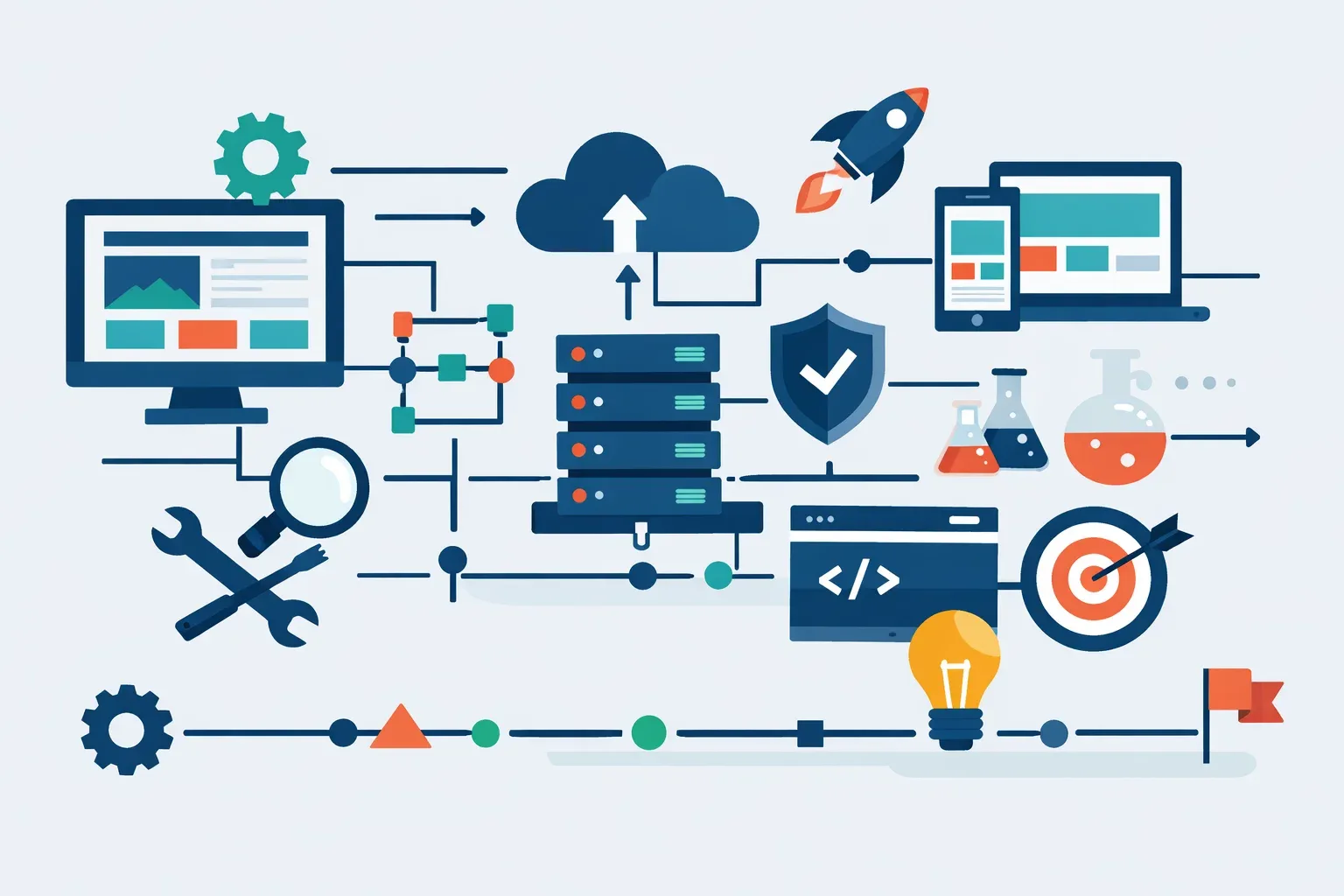
A realistic enterprise web software development roadmap has four phases, each with distinct deliverables and failure modes. Across 20+ enterprise engagements, we’ve observed remarkably consistent timelines — and remarkably consistent places where budgets blow up.
The Four-Phase Framework
| Phase | Duration | Key Deliverables | Best For |
|---|---|---|---|
| Discovery & Architecture | 4–6 weeks | Domain modeling, ADRs, compliance mapping, infrastructure cost model | De-risking technical bets before a single line of production code |
| MVP with Enterprise Hooks | 12–16 weeks | Core workflows live, SSO/RBAC scaffolding, CI/CD pipelines, audit logging | Proving value to stakeholders while embedding non-functional requirements early |
| Scale & Harden | 6–8 weeks | Load testing, pen testing, observability dashboards, runbook documentation | Closing the gap between “works in staging” and “survives production traffic” |
| Operate & Iterate | Ongoing | Feature velocity, SLA monitoring, dependency upgrades, quarterly architecture reviews | Sustaining the system without accumulating the tech debt that triggers rewrites |
Phase two is where most teams underestimate costs. Puppet’s 2024 State of DevOps report found that high-performing engineering teams invest roughly 2x more in deployment pipeline infrastructure than their lower-performing peers (Puppet). Yet CI/CD is routinely budgeted as a weekend task.
The Three Budget Pitfalls We See Repeatedly
- Underestimating CI/CD costs. Enterprise-grade pipelines with parallel test suites, environment provisioning, and compliance gates aren’t free — they’re infrastructure.
- Skipping load testing until launch week. Shopify’s 2023 Black Friday post-mortem showed they begin load testing months before peak events, not days. Most enterprise teams don’t have that discipline baked into their roadmap.
- Treating security audits as a final checkbox. When penetration testing happens in week 22 of a 24-week build, every finding becomes a scope change. Bake it into Phase 2.
The Contrarian Take: Don’t Start with Microservices
Here’s a lesson we learned the hard way: starting with a “perfect” microservices architecture on day one is the single most expensive mistake enterprise teams make. YAGNI — You Aren’t Gonna Need It — applies to infrastructure, not just code. A mid-sized logistics client came to us after spending seven months building Kubernetes-orchestrated microservices for an application that served 200 concurrent users. We consolidated it into a modular monolith in six weeks. Their deployment frequency tripled.
If you’re mapping out a broader initiative, our guide on digital transformation strategy covers how these phases connect to organizational change management. For teams evaluating build-vs-buy decisions across their stack, the custom software development process offers a complementary framework.
Start monolithic. Decompose when coordination costs justify it. Your roadmap should reflect that reality, not an architecture astronaut’s fantasy.
The Architecture Decisions You Make Now Will Compound for Years
Every rewrite we’ve witnessed traces back to the same root cause: architecture decisions made under delivery pressure, without a framework for evaluating long-term consequences. Enterprise web software development doesn’t fail because teams choose the wrong language or framework. It fails because they skip the boring work — domain modeling, ADR documentation, compliance mapping, observability budgets — in favor of shipping features that look good in a sprint demo.
The pattern is predictable. Modular monoliths outperform premature microservices for teams under 50 engineers. Shift-left security saves seven figures over reactive patching. Phase two of any enterprise roadmap will cost more than your estimate. And the tech stack that survives isn’t the trendiest — it’s the one with LTS guarantees, a hiring pipeline in your market, and a security patch cadence you can actually maintain.
Architecture is organizational design expressed in code. If your team structure, compliance requirements, and growth trajectory don’t inform your technical choices, you’re not building a system — you’re building a rewrite timeline.
Written by the editorial team at MyPlanet Design, a Digital Agency / Software Development Company specialising in Custom Software Development & Digital Design.