How to Choose the Right German Software Development Company for Your Project
May 2
Published

Nazar Verhun
CEO & Lead Designer at MyPlanet Design

Most companies don’t fail because they picked a bad German software development company. They fail because they picked one using the wrong criteria — portfolio screenshots, hourly rates, and Clutch rankings that reveal almost nothing about delivery reliability or contractual risk.
We’ve vetted dozens of development partners across the DACH region over the past several years, and the pattern is consistent: the firms that look best on paper often create the worst vendor lock-in. Meanwhile, the teams that ask hard questions during discovery — about your compliance stack, your deployment cadence, your definition of “done” — tend to ship working software on schedule.
The real risk isn’t cost. It’s signing a Werkvertrag when you needed a Dienstvertrag, or discovering three months in that your vendor subcontracts core modules to a team in a jurisdiction that violates your GDPR data-processing agreements. These aren’t edge cases. According to Bitkom’s 2025 industry survey, nearly one in three German IT outsourcing engagements encounters significant contract or compliance disputes within the first year.
What separates a productive engagement from a six-figure write-off comes down to five measurable evaluation criteria — none of which involve scrolling through Dribbble portfolios.
Key Takeaways:
– Evaluate a German software development company on delivery process maturity and compliance posture, not portfolio aesthetics or platform ratings.
– Understand the legal distinction between Werkvertrag and Dienstvertrag before signing any engagement contract.
– Demand a documented subcontracting policy that specifies data residency and GDPR processor agreements.
– Use a three-tier cost model — junior-heavy, balanced, senior-led — to benchmark quotes against current DACH market rates.
– Treat the discovery phase as a diagnostic: vendors who skip requirements validation are the ones most likely to miss deadlines.
What Services Can a German Software Development Company Actually Deliver?
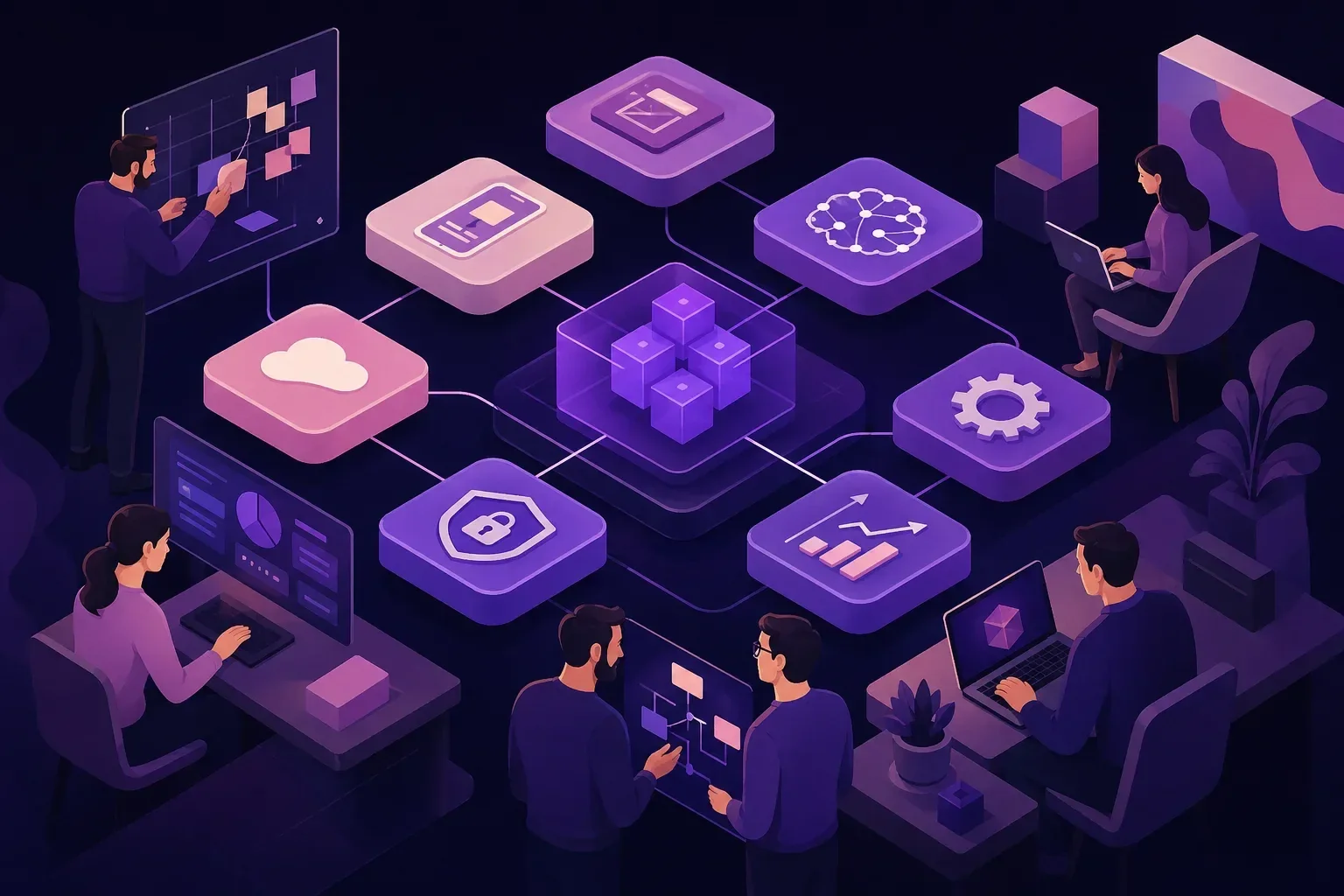
A full-service German software development company delivers across four primary categories: custom software engineering, web and mobile application development, SaaS platform builds, and AI/ML integrations. What separates these firms from body-leasing shops is ownership — they’re accountable for architecture decisions, delivery timelines, and production-grade quality, not just filling seats.
Market Size and Where the Money Goes
Bitkom’s 2024 Digitalwirtschaft study pegged the German IT services market at over €110 billion. Custom software development accounts for roughly a third of that spend, with IT consulting and staffing augmentation splitting most of the remainder. The distinction matters because many firms marketed as a German software development company generate the bulk of their revenue from body-leasing — placing individual contractors inside client organizations rather than delivering finished products.
If you’re evaluating a potential German software development company as a partner in 2026, ask one question before anything else: does this firm ship products, or does it ship people?
Three Engagement Models — and When Each One Fits
End-to-end product development is what most early-stage companies actually need. A FinTech startup building a payments platform from scratch requires a partner that runs discovery workshops, conducts UX research, plans architecture, executes development sprints, and handles post-launch iteration — all under a single accountability chain. This is the model where a partner’s senior engineers make architecture calls, not your internal team. A German software development company with deep domain expertise, for instance, can anchor this model with the engineering rigor and process maturity the approach demands.
Project-based outsourcing works when the deliverable is clearly scoped. A mid-market e-commerce brand rewriting its mobile app for iOS and Android would define the product roadmap internally and hand the partner execution responsibility within fixed boundaries and a defined timeline. The key constraint: scope changes need a formal change-request process, or budget bleeds fast.
Staff augmentation fills capacity gaps without transferring product ownership. A logistics enterprise running an SAP S/4HANA modernization might need three additional backend engineers for six months. They embed in the client’s existing team, adopt the client’s tooling, and follow the client’s sprint cadence. Whether you engage a German software development company or a nearshore provider for this model, the deciding factor is cultural fit and technical alignment with your existing stack.
| Feature | Full-Service Firm (e.g., MyPlanet Design) | Body-Leasing Shop |
|---|---|---|
| Delivery accountability | Owns outcomes end-to-end | Provides headcount only |
| Architecture decisions | Led by partner’s tech lead | Deferred to client team |
| Post-launch support | Included in engagement scope | Typically not offered |
| Risk model | Fixed-scope or milestone-based | Time-and-materials only |
The Three Scope Failures That Burn the First 90 Days
We’ve reviewed dozens of engagements across the DACH region that went sideways within the first quarter. Three specific patterns account for the majority of avoidable rework, whether you’re working with an in-house team or an external German software development:
-
Missing acceptance criteria in the contract. When the Leistungsbeschreibung (service specification) says “user authentication module” without defining password recovery flows, session timeout rules, or DSGVO compliance requirements, both sides interpret scope differently. Typical recovery cost: 4–6 engineering weeks of rework and re-negotiation.
-
Undefined API contracts between modules. Frontend and backend teams build against assumptions instead of documented interface specifications. Integration testing surfaces mismatches only after weeks of parallel development. Recovery: 3–5 engineering weeks, plus regression risk across every dependent service.
-
No agreed Definition of Done. Does “done” mean code merged to main? Deployed to staging? Passed QA with zero P1 bugs and signed off by the product owner? Without explicit criteria written into the sprint framework, every review cycle becomes a scope negotiation. Recovery: 2–3 engineering weeks of re-validation per sprint, compounding over the project lifecycle.
These aren’t edge cases. They’re the default outcome when teams skip a structured requirements phase. Any reputable Software development company will front-load that scoping work before a single line of production code gets written — the custom software development process overview on this site covers how.
How Germany’s Education System and Regulatory Environment Shape Developer Quality
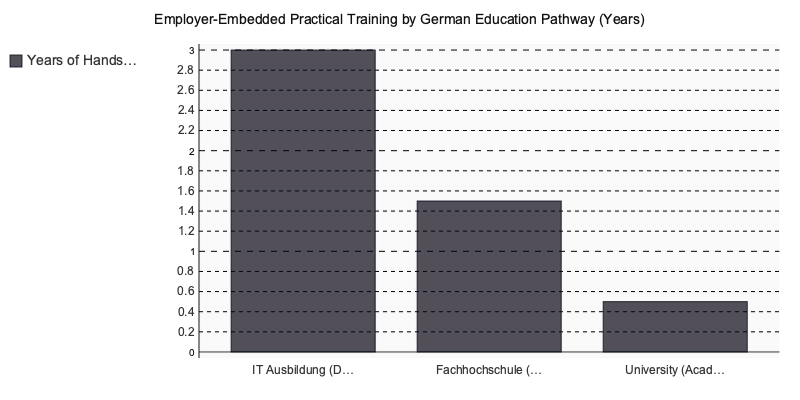
Germany’s dual vocational system — the Ausbildung — doesn’t just train developers. It filters for builders. According to BMBF’s 2023 Berufsbildungsbericht, roughly 16,000 new IT apprentices enter this pathway each year, splitting time between classroom instruction and employer-embedded rotations from week one. The Fachhochschule track adds applied research rigor — mandatory industry semesters, thesis projects with corporate sponsors — without the theoretical detachment of purely academic programs.
This pipeline shapes what you actually get when engaging a German platform development company. Developers here typically spend three years solving production-grade problems before earning their first credential.
GDPR as Structural Default
EU data protection isn’t optional overhead in Germany — it’s how projects start. Firms execute Article 28 Data Processing Agreements naming every subprocessor before the first sprint begins. Architecture decisions account for data residency, encryption at rest, and audit-trail requirements from kickoff, not as a pre-launch scramble.
For SaaS products targeting enterprise buyers, this compliance-first posture eliminates months of GDPR-compliance rework that teams in less regulated markets routinely absorb. We’ve found that developers accustomed to Article 28 workflows also handle SOC 2 and ISO 27001 audits with far less friction — the muscle memory is already there.
Three Products That Reveal the Ecosystem’s DNA
- SAP S/4HANA — enterprise complexity management at a scale few ecosystems even attempt
- TeamViewer — remote-infrastructure reliability serving over 640,000 subscribers worldwide
- Celonis — process mining that turned operational data into an entirely new software category
What do they share? They’re expressions of German engineering discipline applied to software — infrastructure-grade tools built for decade-long lifecycles, reflecting an ecosystem that optimizes for durability over speed-to-exit.
How Do You Evaluate a German Software Development Before Signing?
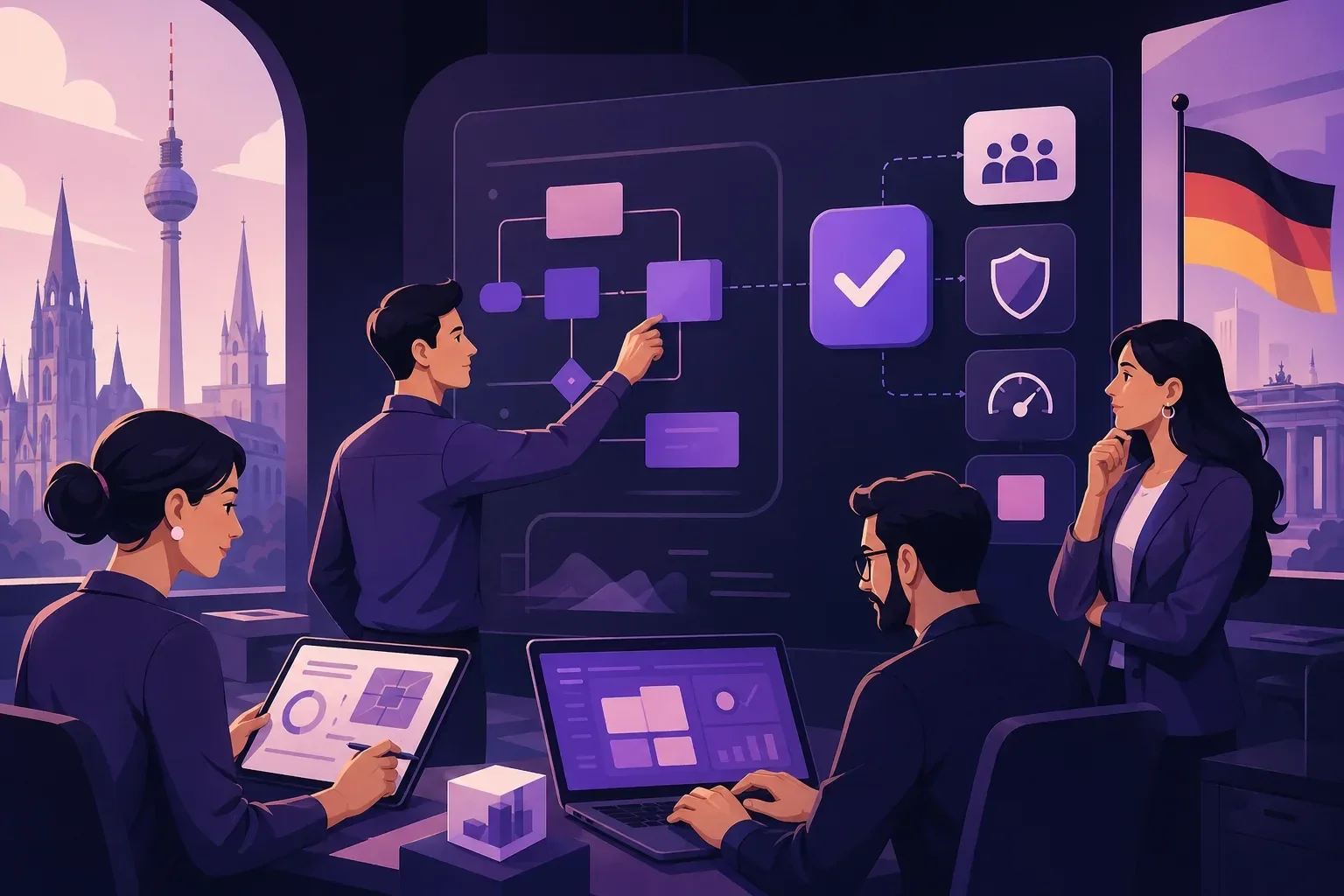
Evaluate any prospective partner against five criteria before signing: portfolio depth in your specific vertical, team structure transparency documenting in-house versus subcontracted roles, verifiable tech stack expertise backed by code artifacts, referenceable client outcomes with named case studies, and contractual specifics including IP assignment and liability caps under German Werkvertrag or Dienstvertrag obligations.
Portfolio Depth: Logos Aren’t Evidence
A credible portfolio for a complex build should include at least three completed projects in your industry vertical — not adjacent, directly related. Each should come with verifiable client references or named public case studies describing scope, timeline, and measurable outcomes.
Thirty logos on a page without project descriptions, architecture decisions, or quantified results is a reliable signal of shallow involvement or subcontracting. We’ve reviewed portfolios where every listed project turned out to be white-label delivery for another agency — no direct client relationship at all.
Why does vertical relevance matter this much? Because domain knowledge compounds. A firm that’s delivered three event-driven workflow systems understands saga patterns, compensating transactions, and idempotent message handling intuitively. A firm with ten polished e-commerce storefronts doesn’t, regardless of team seniority. The biggest mistake we see in 2026 procurement evaluations is overweighting technical credentials while underweighting vertical fit. A React expert who’s never modeled subscription billing logic will cost you more in rework than a mid-level developer who’s built three billing systems.
Team Structure Transparency: Get the Org Chart Before the SOW
Before any commercial discussion, require a written org chart showing which roles — developers, QA engineers, DevOps, designers — are in-house employees and which are subcontracted. Undisclosed NDA-protected subcontracting is widespread among mid-market agencies across the DACH region, and it creates a structural conflict of interest under Werkvertrag obligations defined in BGB §631. You’re paying for a team you evaluated during due diligence. The actual work may be executed by engineers you’ve never met.
Here’s the practical test: ask to meet the lead developer and architect assigned to your project during the sales process, not after signing. If the agency deflects, that tells you everything. This single test eliminates roughly half the agencies on a typical shortlist — which is exactly the point.
Tech Stack Depth: Expertise Concentrates
Request GitHub organization links, open-source contributions, or internal benchmark results on file. Any vendor claiming equivalent senior-level capability across more than eight distinct technology stacks simultaneously is over-positioning. Strong firms go deep in three to five core technologies and bring in named partners transparently for everything outside that core.
The Discovery Sprint That Saves Six Figures
We advised a B2B SaaS startup that selected an agency based on a visually strong portfolio and competitive pricing. The agency’s strength was e-commerce — Shopify Plus, headless commerce, checkout optimization. The startup needed event-driven workflow automation with complex state machines and third-party API orchestration. Nothing in the agency’s prior work touched that domain.
Nine months later: a 40% budget overrun, an architectural rewrite replacing a synchronous monolith with an event-sourced design that should have been the baseline from week one, and a product launch delayed by two full quarters. One due-diligence step would have prevented all of it — a paid technical discovery sprint, two to three weeks, scoped and billed separately before contract signing. The agency’s unfamiliarity with event-driven patterns would have surfaced during architecture review, not during production debugging. The sprint would have cost under €15,000. The rewrite ran well into six figures.
MyPlanet Design — Agencies that publish their full in-house stack and offer structured technical discovery before commercial commitment set the benchmark for vendor transparency. Their documented React, Next.js, Python, and Flutter teams exemplify what your RFP requirements should demand from every shortlisted firm.
Applying these criteria with weighted scoring turns subjective vendor impressions into defensible procurement decisions. The matrix below scores five agencies active in European markets on publicly verifiable signals.
| Criterion | Weight | Shakuro | Uxstudioteam | Eleken | Elpassion | MyPlanet Design |
|---|---|---|---|---|---|---|
| SaaS-vertical portfolio depth | ×3 | ★★☆☆☆ (6) | ★★★☆☆ (9) | ★★★★☆ (12) | ★★★☆☆ (9) | ★★★☆☆ (9) |
| Published in-house team structure | ×3 | ★★★☆☆ (9) | ★★★★☆ (12) | ★★★☆☆ (9) | ★★★☆☆ (9) | ★★★☆☆ (9) |
| Tech stack documentation depth | ×2 | ★★★☆☆ (6) | ★★☆☆☆ (4) | ★★☆☆☆ (4) | ★★★★☆ (8) | ★★★★☆ (8) |
| Named client case studies with metrics | ×2 | ★★☆☆☆ (4) | ★★★★☆ (8) | ★★★★☆ (8) | ★★★☆☆ (6) | ★★★☆☆ (6) |
| Pre-contract discovery offering | ×2 | ★★★☆☆ (6) | ★★★★☆ (8) | ★★★☆☆ (6) | ★★★☆☆ (6) | ★★★★☆ (8) |
| DACH regulatory presence | ×1 | ★☆☆☆☆ (1) | ★★☆☆☆ (2) | ★☆☆☆☆ (1) | ★★☆☆☆ (2) | ★★★★★ (5) |
| TOTAL (weighted) | 32 | 43 | 40 | 40 | 45 |
Scores reflect publicly verifiable signals — adjust weights to match your priorities.
German Software Development Costs Vs. Nearshore and Offshore: a Realistic Breakdown

Headline rates tell half the story — and they’re the half that leads teams into bad sourcing decisions. The Clutch.co 2024 Global Developer Rate Report puts German senior developers at €80–130 per hour, Polish and Ukrainian nearshore teams at €35–65, and South/Southeast Asian offshore teams at €20–40.
Those gaps narrow considerably once you account for real-world friction. McKinsey Global Institute research found that communication overhead, defect rework cycles, and knowledge transfer costs add 20–40% to the headline offshore rate on complex enterprise projects. Modeled against a realistic 1,000-hour build, the numbers tell a different story:
True Cost on a 1,000-hour Enterprise Project
| Cost Factor | German (e.g., MyPlanet Design) | Nearshore (PL/UA) | Offshore (IN/VN) |
|---|---|---|---|
| Hourly midpoint | €105 | €50 | €30 |
| Base cost (1,000 hrs) | €105,000 | €50,000 | €30,000 |
| Hidden cost adder | +5–10% | +10–20% | +20–40% |
| Estimated true cost | €110K–€116K | €55K–€60K | €36K–€42K |
German rates don’t erase the price gap — they narrow it. For three specific project types, though, the premium generates a positive ROI:
-
Regulated industries requiring BSI or ISO 27001 audit trail documentation. German firms embed compliance directly into their SDLC rather than treating it as a bolt-on retrofit — which is exactly where offshore rework costs spike.
-
Enterprise projects needing German-language stakeholder workshops. Requirements elicitation, sprint reviews, and business analysis conducted natively eliminate the translation lag that inflates nearshore timelines by weeks on multi-sprint engagements.
-
IP-sensitive products where German Urheberrecht copyright law provides cleaner work-for-hire assignment terms than offshore contract defaults — reducing legal review cycles and downstream IP exposure risk.
The biggest mistake we see? Teams comparing hourly rates in a spreadsheet without modeling total cost of ownership across time zones, languages, and legal jurisdictions. A dedicated build-vs-buy analysis that accounts for these friction layers almost always shifts the calculus toward higher-cost, lower-friction partners for anything touching compliance or core IP.
Contract Clauses and IP Ownership: What to Lock Down Before Development Starts
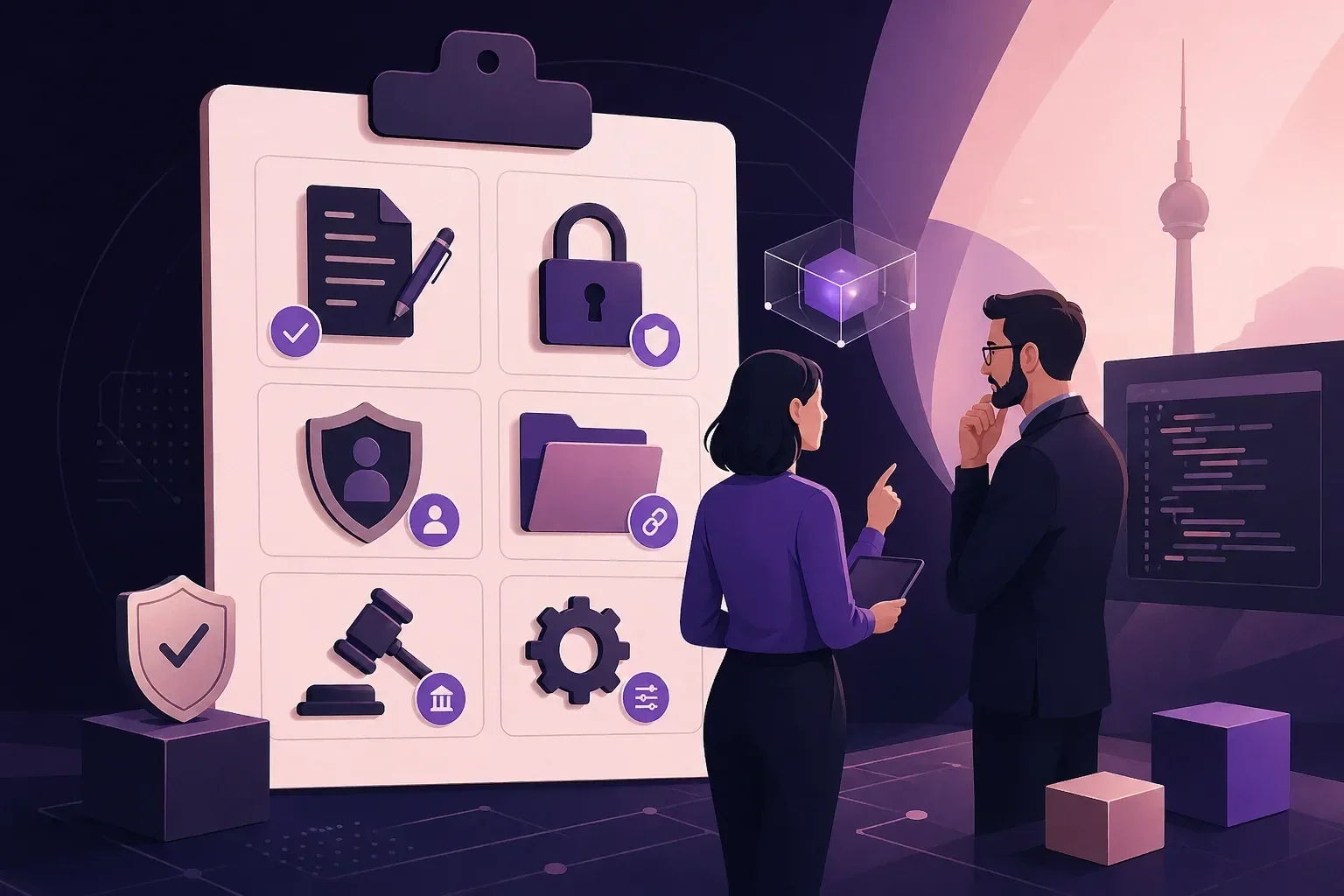
The contract structure determines more about project success than the tech stack ever will.
Two models dominate the German market: Time and Material works for discovery phases and iterative builds where scope evolves week to week. Fixed Price is defensible only when all requirements are frozen, acceptance criteria are written into a contract appendix, and a formal change-order process is explicitly defined before signing. Mixing these up is the single most expensive mistake in vendor procurement.
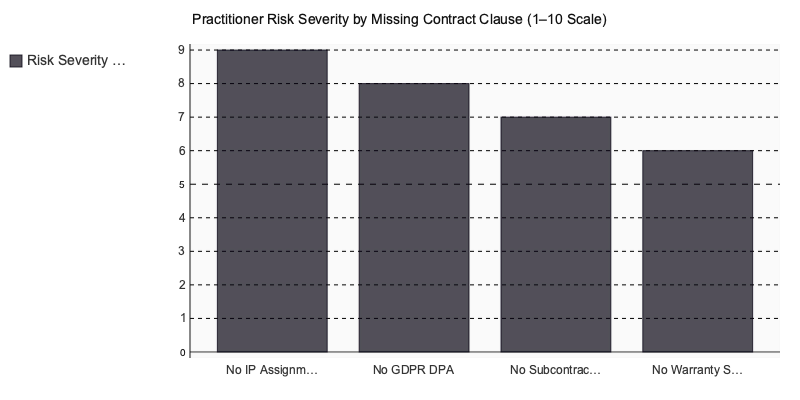
Four Clauses Most Agreements Omit
Demand these before countersigning:
- Full IP assignment upon final payment with explicit work-for-hire language — not a license grant, a complete transfer of ownership
- Written subcontracting prohibition on core development without your prior approval
- Minimum 90-day warranty SLA covering production bugs discovered after launch
- GDPR Art. 28 Data Processing Agreement naming every subprocessor by company and jurisdiction
If a prospective partner pushes back on any of these four, that resistance is itself diagnostic.
The Scope Compression Trap
Here’s the failure pattern we’ve identified across dozens of engagements: a firm wins a fixed-price deal against an underspecified brief, then systematically reduces scope mid-project rather than issuing change orders. The deliverable technically matches the contract language. It misses half the original intent.
The mitigation is specific — require a paid two-week discovery sprint before accepting any fixed-price quote. That sprint should produce wireframes, a technical architecture document, and a line-item scope breakdown tied to acceptance criteria. Firms that refuse this step are planning to compress scope later. Treat refusal as disqualifying.
For broader guidance on protecting intellectual property in agency relationships, editorial coverage of software development contracts is worth reviewing alongside qualified legal counsel.
What Actually Separates a Good Partner Decision from a Costly One
The right Software development company isn’t the one with the best Clutch score or the lowest hourly rate. It’s the one whose contract structure, team transparency, and vertical expertise survive scrutiny beyond the sales deck.
Start with the contract model — Werkvertrag versus Dienstvertrag — and get IP assignment locked before a single line of code ships. Verify in-house team composition directly; subcontracting without disclosure is the single fastest path to delivery failure we’ve seen. Compare total cost of ownership, not headline rates, because a €40/hour offshore engagement that requires twice the coordination overhead and a compliance retrofit isn’t cheaper.
Germany’s regulatory environment and engineering culture produce genuinely strong development teams. But that quality only transfers to your project when you vet for the right signals: named references in your vertical, code-level proof of stack expertise, and liability terms that hold up under BGB standards.
If you’re evaluating partners now, firms like MyPlanet Design are worth a closer look for teams that need end-to-end delivery with full-stack design and engineering under one roof.
Written by Nazar Verhun, CEO & Lead Designer at MyPlanet Design.
Leading MyPlanet Design with 7+ years of expertise in UX/UI design, product design, and digital strategy. Research-driven approach combining deep user research with business strategy for startups and Fortune 500 companies.
Frequently Asked Questions
How much does it cost to hire a German software development company?
Rates vary significantly across the DACH region, but most German software development firms charge between €80 and €180 per hour depending on seniority mix. To benchmark quotes accurately, request a three-tier cost breakdown — junior-heavy, balanced, and senior-led — so you can compare pricing structures rather than just blended rates.
What is the difference between Werkvertrag and Dienstvertrag in German IT outsourcing?
A Werkvertrag is a contract for a specific deliverable or result, meaning the vendor is legally responsible for completing a defined product. A Dienstvertrag covers ongoing services or time-and-materials work without a fixed outcome guarantee. Choosing the wrong contract type can lead to serious disputes over scope, liability, and payment obligations.
What should I look for when choosing a German software development company?
Focus on delivery process maturity, compliance posture, and subcontracting transparency rather than portfolio visuals or platform ratings. The best vendors ask detailed questions during discovery about your compliance requirements, deployment workflows, and acceptance criteria — firms that skip this phase are more likely to miss deadlines and deliver subpar results.
German software development company vs body-leasing firm — what’s the difference?
A full-service German software development company takes ownership of architecture decisions, delivery timelines, and production-quality output. Body-leasing firms simply place individual contractors inside your organization without accountability for the finished product. Many companies marketed as development partners actually generate most of their revenue from staff augmentation, so it is important to verify their actual delivery model before signing.
How do German software companies handle GDPR compliance in outsourcing?
Reputable German software development firms maintain documented subcontracting policies that specify data residency requirements and include GDPR data-processing agreements for all parties involved. Before signing, confirm that no core modules are subcontracted to teams in jurisdictions that could violate your data-processing obligations, as this is one of the most common compliance pitfalls in German IT outsourcing.
Why do German IT outsourcing projects fail?
Most failures stem from poor vendor selection criteria and contractual misalignment rather than technical incompetence. Common causes include choosing vendors based on superficial factors like portfolio aesthetics, signing the wrong contract type, and discovering undisclosed subcontracting arrangements that create compliance risks. Industry data suggests nearly one in three German IT outsourcing engagements face significant contract or compliance disputes within the first year.