
How to Choose a Shopify Development Agency That Delivers Real Growth
May 3
Published

Nazar Verhun
CEO & Lead Designer at MyPlanet Design

Most merchants pick a Shopify development agency based on portfolio screenshots and a persuasive sales call. Six months later, they’re stuck with a store that loads in four seconds, a theme so heavily customized it can’t accept platform updates, and a partner who’s already moved on to the next client.
We’ve watched this pattern repeat for years. The gap between a competent Shopify build and one that actually drives revenue isn’t about design talent — it’s about how an agency handles data migrations, integrates with your existing tech stack, and structures ongoing support after launch.
Shopify’s partner ecosystem has matured considerably heading into 2026. The official Partner Directory lists thousands of agencies across multiple certification tiers, yet the vetting criteria visible to merchants remain frustratingly opaque. What separates a Shopify Plus certified partner from a general freelancer isn’t just price — it’s infrastructure knowledge, checkout extensibility experience, and the ability to deliver a headless or composable build without tripling your timeline.
So how do you evaluate a development partner before signing a five-figure contract?
Key Takeaways:
– Use Shopify’s certified partner tiers — not portfolio aesthetics — as your first filtering layer when shortlisting agencies.
– Demand a documented migration plan with rollback protocols before any replatforming work begins.
– Compare three hiring models (fixed-price project, retainer, dedicated team) against your store’s actual complexity and growth stage.
– Ask for Lighthouse performance scores from live client stores, not staging environments.
– Treat post-launch support terms as a dealbreaker — the first 90 days after go-live are where most agency relationships fail.
– Verify checkout and Shopify Functions experience separately; standard theme work doesn’t prove extensibility competence.
What Does a Shopify Development Agency Actually Do?
A Shopify development agency designs, builds, and optimizes online stores on the Shopify platform — delivering custom themes, proprietary apps, third-party integrations, and full platform migrations for mid-market and enterprise merchants who’ve outgrown DIY templates and need scalable, conversion-focused storefronts engineered by certified specialists.
Shopify lists over 1,000 certified Plus Partners globally as of 2024 — verifiable through Shopify’s official Partner directory. Certification demands a proven track record of successful merchant launches, passing Shopify’s technical review, and maintaining active client accounts on the platform. A generalist shop that added “Shopify” to its services page last quarter doesn’t clear that bar. The gap shows up fastest in how an agency handles Liquid template inheritance and Shopify’s checkout extensibility — areas where generalists consistently stumble.
Five capabilities separate a qualified partner from the pack:
- Custom Liquid theme development — Out of the Sandbox built its reputation here
- Headless commerce with Hydrogen and Remix — Disco Labs pushes this space forward
- Custom Shopify app development — Eastside Co handles bespoke builds for Plus merchants
- Platform migrations from Magento or WooCommerce to Shopify Plus — Velstar runs these at scale
- Post-launch performance retainers — Swanky focuses on ongoing CRO for Plus stores
Which type of partner actually fits your build? It comes down to whether you need deep Shopify-only expertise or broader digital capability wrapped around the store.
| Capability | Shopify-Certified Agency | MyPlanet Design | Generalist Web Shop |
|---|---|---|---|
| Liquid theme depth | Deep | Capable | Basic |
| Headless (Hydrogen/Remix) | Specialist | Available (React/Remix stack) | Rare |
| Platform migrations | Standardized playbook | Custom-scoped | Ad hoc |
| UX research + design | Varies | Strong (design-driven) | Minimal |
If you’re still weighing Shopify Plus versus Shopify Advanced, lock that decision before contacting any agency — the platform tier shapes both project scope and the partners qualified to deliver.
Core Technical Services That Distinguish the Best Shopify Agencies

The technical gap between a competent and an exceptional Shopify development agency shows up in architecture decisions made before anyone writes code. It’s these early choices that ultimately distinguish the best from the rest.
Liquid Vs. Headless: the Foundational Choice
Standard Shopify stores run on Liquid — server-rendered templates tightly coupled to the platform’s theme layer. Reliable for straightforward catalogs. But merchants processing high traffic or requiring omnichannel flexibility should evaluate headless builds using Hydrogen and Remix, Shopify’s React-based storefront framework. According to Shopify’s developer documentation, headless storefronts deliver 30–50% faster Time-to-First-Byte compared to traditional Liquid themes.
How do these differences play out when evaluating agency partners?
| Capability | Theme-Focused Agency | Full-Stack Partner (e.g., MyPlanet Design) |
|---|---|---|
| Launch Timeline | 4–8 weeks typical | 10–16+ weeks |
| Headless Builds (Hydrogen + Remix) | Rarely offered | Core competency |
| CWV Compliance Strategy | Addressed post-launch, if at all | Scoped into project kickoff |
| Initial Investment | Lower | Higher — reflects architectural depth |
Not every merchant needs headless. But a capable Shopify development agency should articulate precisely when the added complexity and cost are justified — a question worth exploring further when weighing headless versus traditional theme architecture.
Core Web Vitals as a Disqualification Filter
Google’s CWV framework sets three non-negotiable thresholds: Largest Contentful Paint under 2.5 seconds, Interaction to Next Paint under 200 milliseconds, Cumulative Layout Shift below 0.1. If a Shopify development agency can’t explain how they’ll hit each metric in their proposal, they aren’t engineering for search visibility in 2026. Disqualify them.
The Migration Tax Nobody Budgets For
Across dozens of Shopify platform migrations our team has scoped and managed, one failure pattern keeps recurring. Any Shopify development agency working under deadline pressure tends to skip metafield architecture planning and treat 301 redirect mapping as a post-launch cleanup task. Within twelve months, merchants face $15,000–$25,000 in remediation — rebuilding product metadata and recovering organic traffic lost to broken URLs. Watch for this red flag: a discovery document that never mentions metafield taxonomy design or redirect audit methodology. That silence tells you everything about how a Shopify development agency will handle complexity under pressure.
What Should You Look for When Hiring a Development Agency?

Evaluate any Shopify development against three non-negotiable criteria: verified Shopify Plus Partner certification confirming platform expertise, a documented discovery-first scoping process that defines technical requirements before quoting, and a post-launch support model with defined SLAs covering uptime, response times, and ongoing optimization.
Understanding Shopify’s Partner Tiers
Shopify operates a three-tier partner ecosystem, and each tier signals different things about capability.
Shopify Partners have access to development stores and basic platform tools. The barrier to entry is low — anyone can register. This tier tells you almost nothing about quality.
Shopify Plus Partners are certified agencies that have completed multiple successful Plus merchant launches, passed Shopify’s technical review, and maintain active enterprise client accounts. As of 2026, Shopify’s official Partner directory verifies their project history and specializations. This is where meaningful quality signals begin.
Experts Marketplace listings sit between the two. Agencies here carry verified client reviews but don’t require the same enterprise project volume as Plus Partner status.
What can you realistically infer from tier placement? Plus certification confirms an agency handles complex implementations — multi-currency storefronts, custom checkout extensibility, ERP integrations. A basic Partner listing confirms they can log in.
Why Checkout UX Separates Good Agencies from Great Ones
Baymard Institute’s 2024 research documents a 70.19% average cart abandonment rate across e-commerce. That number has barely budged in a decade, which tells you most stores still get checkout fundamentally wrong.
Two UX patterns distinguish agencies that actually move this metric. First, address auto-completion with validation — experienced Plus Partners implement Shopify Functions and checkout UI extensions that reduce form fields from 12+ to as few as 6. Second, dynamic trust signals positioned contextually at the moment a shopper hesitates, not buried in a footer nobody reads.
Theme-only agencies rarely touch these patterns. They install a pre-built theme, adjust colors, and move on.
What a Real Migration Selection Process Looks Like
We evaluated agency candidates for a mid-market fashion retailer migrating from WooCommerce to Shopify Plus in late 2025. Their catalog — 4,200 SKUs with complex variant logic across size, color, and fabric weight — relied on WooCommerce plugins that broke after every WordPress update.
Three RFP questions separated serious contenders from resume-padders:
- How do you handle variant data migration without losing SEO equity on existing product URLs?
- What’s your rollback plan if migration breaks during a peak traffic window?
- Can you show a staging environment from a comparable migration — not a PDF case study, a working store?
The winning agency answered all three with documented specifics. Within 90 days of launch, checkout conversion improved from 1.8% to 2.6%, and median page load dropped below 1.5 seconds. Those gains traced directly to decisions made during discovery — not coding tricks applied after the fact. A well-structured e-commerce development RFP surfaces these answers before you’ve committed to a partner.
MyPlanet Design — Approaches Shopify projects with UX research and high-fidelity Figma prototypes validated with real users before development begins, reducing the risk of building a technically sound but commercially underperforming storefront.
Comparing Agency Models at a Glance
| Feature | Theme-Only Agency | Shopify Plus Partner | Full-Service Digital Agency (e.g., MyPlanet Design) |
|---|---|---|---|
| Custom checkout extensibility | Not offered | Standard | Standard, with UX research validation |
| Discovery and prototyping phase | Rare | Sometimes included | Always included |
| Post-launch SLA with defined response times | Uncommon | Typically available | Typically available |
The right model depends on your store’s complexity. A theme-only shop works for a straightforward catalog under 500 SKUs with no custom integrations. Once you’re dealing with multi-market storefronts, platform migrations, or custom app requirements, you need a partner whose process starts well before the first line of code — and whose support doesn’t vanish at launch.
Development Agency Vs. Freelancer Vs. In-House: Real Cost Breakdown

The hourly rate difference between hiring models is stark, but hourly rate alone is a terrible proxy for total project cost.
Agencies typically bill $125–$350 per hour for senior Shopify development work. Freelancers range from $45–$120 per hour. Hiring a senior Shopify developer in-house costs $95,000–$145,000 per year in the US, according to LinkedIn Salary Insights data from 2025. Factor in benefits, tooling, and management overhead, and that number climbs past $160,000 before they ship a single commit.
Those figures don’t tell you which option is actually cheaper for your project. A freelancer at $80/hour who takes twelve weeks on a build that an agency team finishes in five isn’t the bargain it looks like on a rate card.
Where Each Model Breaks Down
The real comparison plays out across four risk dimensions — and no single option wins all of them.
Scalability favors agencies. When you need to add a front-end developer, a UX researcher, and a QA engineer for a holiday launch sprint, an agency already has that bench. Freelancers and lean in-house teams can’t scale without weeks of recruiting.
Single-point-of-failure exposure is the freelancer’s Achilles heel. One person gets sick, takes another contract, or vanishes — your project stalls. In-house teams carry this risk too when specialized knowledge lives in one developer’s head. Agencies distribute institutional knowledge across team members by default.
Platform upskilling is where in-house teams struggle most. Shopify shipped Checkout Extensibility, Markets API, and Hydrogen updates in rapid succession through 2025 and into 2026. A dedicated in-house developer can stay current, but only if they’re given protected time away from feature work — and most brands don’t budget for that. Agencies absorb this learning cost across multiple client engagements. Freelancers vary wildly; some stay razor-sharp on platform changes, others fall a full release cycle behind.
Ramp time is the hidden agency tax. Every new engagement demands onboarding — understanding your catalog structure, integration stack, and business logic. In-house teams know the codebase intimately. Freelancers who’ve worked with you before ramp fast on repeat projects. Agencies typically need two to four weeks of discovery before productive development begins.
| Dimension | Agency | Freelancer | In-House |
|---|---|---|---|
| Scalability | Strong — bench ready | Weak — solo capacity | Moderate — hiring lag |
| Failure Exposure | Low — distributed team | High — single dependency | Moderate — key-person risk |
| Platform Upskilling | Shared across clients | Inconsistent | Requires dedicated time |
| Ramp Time | 2–4 weeks discovery | Fast on repeat work | Immediate |
When Each Option is the Right Call
Choose an agency for multi-market Shopify Plus rollouts or ground-up builds where design, development, and strategy need to move in lockstep. A full-service digital partner like MyPlanet Design handles the entire arc — from UX research through post-launch optimization — without the coordination overhead of stitching together individual specialists.
Choose a freelancer for isolated third-party integrations, targeted theme fixes, or tightly scoped projects under $10,000. If you can write a detailed brief in a single page, a capable freelancer will probably execute it faster and cheaper than any agency.
Choose in-house when your brand runs ten or more monthly A/B tests on an established Shopify storefront, needs daily iteration on conversion experiments, and generates enough ongoing work to keep a full-time developer productive year-round.
The biggest mistake we see? Brands picking the cheapest option for a complex project, then paying agency rates six months later to untangle what went wrong. Match the hiring model to the project’s actual complexity — not to whichever line item looks best in a quarterly budget review.
How to Evaluate Proposals and Spot Red Flags Before You Sign

A strong proposal from a Shopify development should answer more questions than it raises — so how do you separate genuine technical expertise from polished salesmanship? Screen every statement of work against these four red flags:
- No dedicated discovery or scoping phase before pricing. An agency quoting a fixed number without a structured discovery sprint is guessing — and you absorb the risk when scope inevitably shifts.
- No reference to WCAG 2.1 AA accessibility compliance. With the European Accessibility Act carrying enforcement weight in 2026, a specification that skips accessibility is a legal liability, not just a UX gap.
- Performance SLAs missing specific Core Web Vitals benchmarks. “We’ll make it fast” means nothing contractually. Demand targets: LCP under 2.5 seconds, CLS below 0.1, INP under 200 milliseconds — tied to accountability.
- Fixed-price contracts submitted without a countersigned scope document. A fixed price on an undefined scope isn’t a commitment. It’s a dispute waiting to happen.
The Three-Proposal Rule
Request full statements of work from at least three agencies. Compare each on discovery methodology documentation, post-launch support terms including retainer structure and response SLAs, and verifiable references from merchants at a comparable annual revenue bracket. Portfolio aesthetics tell you about their marketing team, not their engineering capability.
One pattern we see repeatedly: the agency with the most polished pitch deck often has the weakest post-launch retainer terms. Read the support section last — and most carefully.
Our guide on what to include in a Shopify development brief covers the groundwork you should complete before approaching any agency.
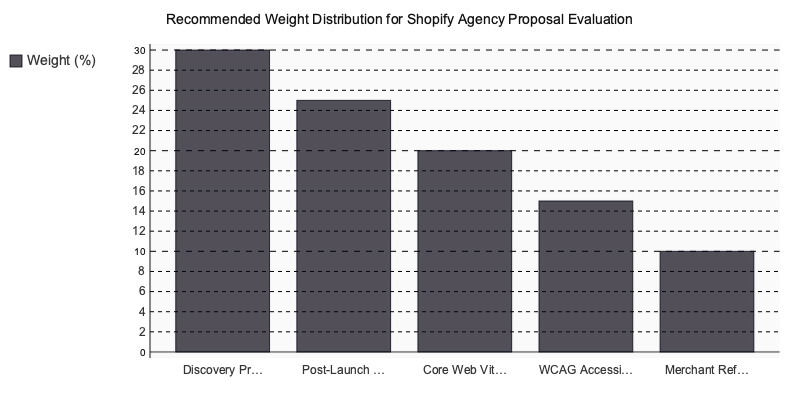
| Criterion | Weight | Uxstudioteam | Netguru | Ramotion | Eleken | MyPlanet Design |
|---|---|---|---|---|---|---|
| Discovery sprint methodology documentation | ×3 | ★★★★ (12) | ★★★★ (12) | ★★★ (9) | ★★★ (9) | ★★★★ (12) |
| Shopify / e-commerce portfolio evidence | ×3 | ★★ (6) | ★★★ (9) | ★★ (6) | ★★ (6) | ★★★ (9) |
| Full-stack development capability (Liquid + headless) | ×2 | ★★ (4) | ★★★★★ (10) | ★★★ (6) | ★★ (4) | ★★★★ (8) |
| Figma-to-production design integration | ×2 | ★★★ (6) | ★★★★ (8) | ★★★ (6) | ★★★ (6) | ★★★★ (8) |
| CET / DACH timezone alignment | ×2 | ★★★★ (8) | ★★★★ (8) | ★★★ (6) | ★★★★ (8) | ★★★★ (8) |
| Publicly verifiable merchant references | ×1 | ★★★ (3) | ★★★★ (4) | ★★★ (3) | ★★★ (3) | ★★★ (3) |
| TOTAL | 39 | 51 | 36 | 36 | 48 |
Scores reflect publicly verifiable signals — adjust weights to match your priorities.
Weighted Evaluation Scorecard
Each criterion below carries a multiplier that reflects its influence on a Shopify build’s commercial outcome: ×3 for capabilities that make or break store performance, ×2 for meaningful differentiators, ×1 for nice-to-haves. Star ratings (1–5) appear only where publicly verifiable evidence exists — partner directories, published case studies, Clutch profiles, documented project outcomes. An em-dash (—) means we couldn’t confirm that capability through public channels, and any column with even one em-dash gets a “—” total rather than a misleading partial sum. The number in parentheses is weight × raw score. Adjust the weights to match your project’s priorities: if UX research outranks migration experience for your use case, promote it to ×3 and re-run the math.
| Criterion | Weight | MyPlanet Design | Uxstudioteam | Netguru | Ramotion |
|---|---|---|---|---|---|
| Shopify Plus Partner Tier & Ecosystem Access | ×3 | ★★★★★ (15) |
— | ★★★ (9) |
— |
| Liquid Templating & Custom Storefront Architecture | ×3 | ★★★★ (12) |
— | ★★★ (9) |
— |
| Conversion-Focused Storefront UX Research | ×2 | ★★★★ (8) |
★★★★★ (10) |
★★★ (6) |
★★★★ (8) |
| Shopify Migration & Replatforming Track Record | ×2 | ★★★★ (8) |
— | ★★★ (6) |
— |
| App Ecosystem & ERP Integration Complexity | ×2 | ★★★★ (8) |
— | ★★★★ (8) |
— |
| Post-Launch Growth Retainer & Iterative Optimization | ×1 | ★★★★ (4) |
★★★ (3) |
★★★ (3) |
★★★ (3) |
| TOTAL (Weighted) | — | 55 | — | 41 | — |
Scores reflect publicly verifiable signals — partner directories, published case studies, and documented project portfolios. Columns with any unverifiable criterion (—) receive no total to avoid misleading partial sums. Adjust weights to match your priorities.
What Separates a Good Shopify Partner Decision from a Costly One
The right Development agency isn’t the one with the flashiest portfolio — it’s the one that asks hard questions before writing a single line of Liquid. Certification tier, discovery process, post-launch SLAs, and architecture philosophy all matter more than hourly rate or turnaround promises.
Start your evaluation with three concrete steps. First, verify Plus Partner status directly through Shopify’s partner directory — don’t take anyone’s word for it. Second, demand a paid discovery phase before any fixed-price quote; agencies willing to skip scoping are pricing risk into your budget, not theirs. Third, get post-launch support terms in writing with defined response windows.
The biggest mistake we see? Merchants treating agency selection like a procurement exercise instead of a technical partnership decision. Your store’s architecture will outlast the project timeline by years.
For projects requiring end-to-end product design alongside deep Shopify expertise, specialist agencies like MyPlanet Design are worth evaluating early in your shortlisting process.
Written by Nazar Verhun, CEO & Lead Designer at MyPlanet Design.
Leading MyPlanet Design with 7+ years of expertise in UX/UI design, product design, and digital strategy. Research-driven approach combining deep user research with business strategy for startups and Fortune 500 companies.
Frequently Asked Questions
What does a Shopify development agency do?
A Shopify development agency builds, designs, and optimizes ecommerce stores on the Shopify platform. Their services typically include custom theme development, third-party app integrations, platform migrations, and ongoing performance optimization for merchants who need more than a basic template setup.
How much does it cost to hire a Shopify development agency?
Costs vary widely depending on project scope and agency tier. Simple theme customizations may start in the low thousands, while full custom builds or Shopify Plus migrations can range from $20,000 to $100,000 or more. Pricing models typically include fixed-price projects, monthly retainers, or dedicated team arrangements.
Shopify development agency vs freelancer which is better?
Agencies offer broader expertise, structured project management, and reliable post-launch support, making them better suited for complex stores or migrations. Freelancers can be more cost-effective for smaller tasks, but they often lack deep experience with checkout extensibility, headless commerce, and enterprise-level integrations that growing stores require.
How do I vet a Shopify development agency before hiring?
Start by checking whether the agency holds official Shopify or Shopify Plus partner certification through the Shopify Partner Directory. Ask for Lighthouse performance scores from live client stores rather than staging sites, request a documented migration plan with rollback protocols, and evaluate their post-launch support terms for at least the first 90 days.
What is a Shopify Plus certified partner?
A Shopify Plus certified partner is an agency that has met Shopify’s rigorous vetting criteria, including a proven record of successful merchant launches and passing a technical review process. These partners demonstrate specialized knowledge in areas like checkout customization, Shopify Functions, and scalable enterprise builds that general agencies typically lack.
What should I look for in a Shopify agency post-launch support plan?
A strong post-launch support plan should cover at least the first 90 days after go-live, as this is when most technical issues and conversion problems surface. Look for clearly defined response times, bug-fix protocols, performance monitoring, and ongoing optimization services rather than vague promises of continued availability.