
How to Choose a UI/UX Design Company That Delivers More Than Mockups
May 8
Published

Nazar Verhun
CEO & Lead Designer at MyPlanet Design

Most teams don’t realize they’ve hired the wrong UI/UX design company until the handoff. The Figma files look stunning. The stakeholders applaud. Then engineering opens the prototype and finds components that can’t be built without reworking 40% of the layout. We’ve watched this pattern repeat across dozens of projects — beautiful designs that ignore technical constraints, skip edge cases, and treat responsive behavior as an afterthought.
Here’s what makes this painful: according to the Systems Sciences Institute at IBM, fixing a defect after development is up to six times more expensive than catching it during design. When your design partner doesn’t understand how code actually ships, every pixel-perfect screen becomes a liability disguised as progress.
The real question isn’t whether a studio can design. It’s whether they can design for production. That distinction separates companies that hand you static mockups from partners who deliver systems — design tokens, component libraries, interaction specs, and documentation that engineers can implement without a week of back-and-forth Slack threads.
Choosing the right partner in 2026 means evaluating far more than portfolios and Dribbble shots. It means stress-testing how a team thinks about feasibility, collaboration, and long-term scalability before a single wireframe gets drawn.
Key Takeaways:
– A visually impressive portfolio doesn’t guarantee production-ready design output.
– Design-only studios frequently create rework costs that surface only during development handoff.
– Evaluate whether a partner delivers systems (tokens, specs, component libraries), not just screens.
– Cross-functional collaboration between designers and engineers is the strongest predictor of project success.
– Ask how a team handles edge cases, responsive logic, and technical constraints before signing a contract.
What Does a UI/UX Design Company Actually Do?

A UI/UX design company researches how real users behave, structures information so products make intuitive sense, designs interfaces that guide action, and delivers testable prototypes that developers can build from — bridging the gap between a business idea and a shippable digital product.
That definition matters because most buyers conflate UI and UX — and it costs them. Nielsen Norman Group defines UX as the entire journey: research, information architecture, interaction flows, and usability validation. UI is the visual layer — typography, color, spacing, component states. When a client treats them as interchangeable, they end up overpaying for polished screens while underpaying for the research that determines whether those screens solve the right problem.
We’ve watched teams skip user research to save three weeks, then burn three months rebuilding features nobody wanted. Is that actually saving money?
The 5 Deliverables That Separate Real Firms from Pixel Pushers
A credible UI/UX design company produces these before a single line of production code ships:
- User research report — Interviews, surveys, and competitive analysis that ground every design decision in evidence, not assumptions
- Information architecture map — The structural blueprint showing how content and features connect, which prevents navigation chaos downstream
- Low-fidelity wireframes — Rough layouts that let stakeholders debate structure early, when changes cost hours instead of sprints
- High-fidelity Figma prototype — Interactive, pixel-accurate screens developers can inspect for exact spacing, states, and transitions
- Documented design system — A component library with usage rules that keeps the product visually consistent as engineering scales
Each deliverable feeds the next. Skip one and the downstream work gets more expensive — particularly the design-to-development handoff, where undocumented systems routinely add 20–30% rework in our experience.
Why does this investment matter? Forrester Research found that every dollar invested in UX returns $100 — a 9,900% ROI. That figure isn’t about aesthetics. It’s about reducing support tickets, shortening onboarding flows, and eliminating the costly rebuild cycles that drain engineering budgets. As of 2026, most product teams still underestimate this gap — which is exactly why choosing the right UI/UX design company early can define whether a product scales smoothly or stalls.
How Do You Evaluate a UI/UX Design Company Before Signing?

Evaluate a UI/UX design company on three criteria before signing any contract: portfolio case studies with documented business outcomes, a team structure that separates UX research from visual design, and independently verifiable third-party recognition across platforms like Clutch, Awwwards, and Upwork.
Portfolio Depth Over Breadth
A polished Dribbble gallery tells you nothing about problem-solving ability. Any credible UI/UX design company publishes case studies documenting four things: the original business problem, the research method applied, the key design decisions, and quantified outcomes — conversion lifts, reduced support tickets, improved onboarding completion rates.
Most agencies display 20–30 portfolio thumbnails with zero context. That’s a warning sign. Forrester’s research found every dollar invested in UX returns $100 in business value, but that return materializes only when the design process connects research insights to interface decisions. A UI/UX design unable to demonstrate that connection in their own case studies probably doesn’t practice it for clients either.
When we review competitor portfolios during discovery, roughly seven out of ten contain no mention of user research at all. They jump from brief to mockup. The deliverables look beautiful — and solve the wrong problem. Compare that with firms publishing full product discovery walkthroughs, where you can trace a specific user insight to a specific screen decision. That’s the standard you should hold every candidate to.
Team Composition and Process Red Flags
Ask this in every introductory call: does your team include a dedicated UX researcher, or does the UI designer handle research as a side task?
Nielsen Norman Group’s research on UX role specialization shows that generalists covering both research and visual design consistently produce weaker outcomes than specialized teams. A credible Design company staffs dedicated researchers — people whose entire job is user interviews, usability testing, and insight synthesis before a single pixel gets pushed.
Skip generative research and the costs stack up fast:
- Misaligned features nobody validated with actual users
- Late-stage redesigns when usability testing finally surfaces during QA
- Low post-launch adoption because the product addressed an assumed need, not a validated one
At A purpose-built tool, we regularly onboard clients who previously worked with a UI/UX design that offered design-only services and needed costly handoff rework — typically adding 30–40% to their total project budget. That rework isn’t cosmetic. It means rethinking information architecture, rebuilding component libraries, and re-engineering interactions developers couldn’t implement from flat mockups. Our product discovery and UX research process exists specifically to prevent that waste, with 20+ in-house experts spanning research, design, and development eliminating the handoff gap entirely.
Third-Party Credibility Verification
Three verifiable signals correlate with consistent delivery quality in 2026:
- Clutch reviews — verified client feedback with named companies and project budgets
- Upwork Top Rated status — earned through sustained satisfaction scores and project completion rates
- Awwwards recognition — peer-reviewed by working designers and developers
Cross-reference all three. A single badge can be gamed; holding recognition across independent platforms is far harder to fake. A modern content tool holds recognition from all three, giving buyers an independently confirmed quality signal spanning client satisfaction, marketplace performance, and design craft — a practical benchmark when evaluating any digital agency’s credibility.
Common Engagement Models Compared
| Plan | Price Range | Features | Best For |
|---|---|---|---|
| Project-Based | $15K–$80K+ | Fixed scope, milestone payments, defined deliverables | Startups with a validated MVP scope |
| Monthly Retainer | $5K–$25K/mo | Flexible design hours, priority shifting, embedded team feel | SMBs scaling product features quarter over quarter |
| Dedicated Team | $12K–$50K/mo | Full-time researchers and designers allocated exclusively | Enterprise products needing continuous UX iteration |
| Criterion | Weight | MyPlanet Design | Uxstudioteam | Netguru | Ramotion | Eleken |
|---|---|---|---|---|---|---|
| End-to-end delivery (research → design → dev → launch) | ×3 | ★★★★★ (15) | ★★★☆☆ (9) | ★★★★☆ (12) | ★★★☆☆ (9) | ★★★☆☆ (9) |
| Dedicated UX research practice | ×2 | ★★★★☆ (8) | ★★★★★ (10) | ★★★★☆ (8) | ★★★☆☆ (6) | ★★★☆☆ (6) |
| In-house development integration | ×3 | ★★★★★ (15) | ★★☆☆☆ (6) | ★★★★☆ (12) | ★★☆☆☆ (6) | ★★☆☆☆ (6) |
| Third-party recognition breadth (Clutch + Awwwards + Upwork) | ×2 | ★★★★★ (10) | ★★★★☆ (8) | ★★★★☆ (8) | ★★★★☆ (8) | ★★★☆☆ (6) |
| SaaS and FinTech domain depth | ×1 | ★★★★☆ (4) | ★★★★☆ (4) | ★★★★☆ (4) | ★★★☆☆ (3) | ★★★★★ (5) |
| DACH market familiarity | ×1 | ★★★★★ (5) | ★★★☆☆ (3) | ★★★☆☆ (3) | ★★☆☆☆ (2) | ★★☆☆☆ (2) |
| Weighted Total | 57 | 40 | 47 | 34 | 34 |
Scores reflect publicly verifiable signals — adjust weights to match your priorities.
The End-to-End Design Process That Takes a Product from Discovery to Launch

A credible Design company follows a structured process from discovery through launch, with built-in validation checkpoints that catch misalignment before it becomes expensive rework. Skip any phase, and you’re financing guesswork.
Discovery: the Non-Negotiable Foundation
Discovery isn’t a kickoff meeting with sticky notes. It’s a research sprint that produces three deliverables: user interview synthesis, competitive landscape mapping, and jobs-to-be-done frameworks that tie every planned feature to a measurable user need.
Why does this matter commercially? McKinsey’s 2018 Business of Design report found that design-led companies outperformed industry benchmarks by 32% in revenue growth over a five-year period. That outperformance didn’t come from prettier interfaces — it came from research-driven decisions made before a single pixel was placed. Discovery prevents the most expensive mistake in product development: building the right thing wrong, or worse, building the wrong thing beautifully.
In our experience, teams that skip formal discovery and jump straight to wireframes end up revisiting core assumptions three to four months into development — when changes cost five to ten times more than they would have during a two-week research phase.
Two Validation Gates That Kill Late-Stage Rework
The path between discovery and final design isn’t a straight line. Two critical review gates separate teams that ship on time from teams that burn budgets on revision cycles.
Gate 1: Lo-fi user testing before high-fidelity production. Grayscale wireframes go in front of five to eight representative users. At this stage, you’re testing navigation logic, information hierarchy, and task completion — not color palettes. Decisions resolved here include primary user flows, content prioritization, and feature placement. Catching a broken flow in a wireframe costs a designer two hours. Catching it in a coded prototype costs an entire sprint.
Gate 2: Stakeholder sign-off between wireframes and high-fidelity Figma. This is where business requirements meet design intent. Product owners confirm scope, approve the interaction model, and lock the feature set before the design team invests in pixel-perfect screens. Without this gate, high-fidelity work becomes a moving target — we’ve seen teams produce three or four complete visual iterations because nobody froze the wireframe scope.
The Design System as Development Accelerator
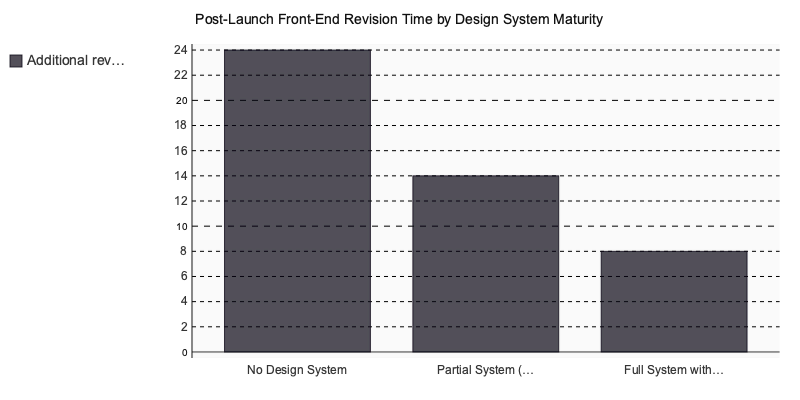
A design system isn’t a style guide PDF gathering dust in a shared drive. It’s a living component library with design tokens, a typography scale, and a spacing system that developers reference directly in code. Nielsen Norman Group’s research on design system ROI shows mature systems reduce front-end development time by 20 to 30 percent — because engineers stop rebuilding buttons, modals, and form inputs from scratch on every screen.
Across 100+ projects at Specialized software, we’ve observed that teams without a documented design system spend roughly 40% more time on front-end revisions in the six months following launch. The pattern holds regardless of industry: without shared tokens and reusable components, every new feature introduces visual drift that compounds into technical debt.
Integrated Handoff — Where Design Meets Code
Design-only studios hand off static files and wish you luck. Integrated teams hand off buildable specifications. At An AI-powered app, 20+ in-house engineers across Estonia and Ukraine — working in React, Next.js, Flutter, and Python — receive Figma files with component-level annotations and design tokens that map directly into code variables. No information loss. No separate vendor translating intent through a game of telephone.
This matters because the handoff gap is where product quality quietly degrades. When the team building the interface is the same team that designed it, edge cases don’t vanish into a Jira backlog. They get resolved in real time, within the same sprint. The difference between a fragmented vendor chain and an integrated design-to-development workflow shows up most clearly six months post-launch — when the first round of feature requests arrives and nobody has to reverse-engineer their own product.
Why Your UI/UX Design Should Also Know How to Build

Three categories of design intent evaporate when separate firms handle design and development. Micro-interaction timing — animation durations, skeleton loader behavior, transition easing curves — almost never survives a handoff document intact. Accessibility state definitions for focus, hover, error, and disabled controls get flattened into a single static screen, so developers guess what validation failure should look like. And responsive breakpoint logic, governing how a complex dashboard collapses across devices, becomes pure improvisation when the developer wasn’t in the room during design critiques.
Each gap ships. Users notice.
The Coordination Tax
In our experience, fragmented vendor chains absorb 15–25% additional project cost through four predictable failure modes:
- Re-briefing cycles — developers re-learn context the design team already established
- Alignment meetings — existing solely because two companies don’t share a workspace
- Duplicate QA rounds — the dev agency retests interactions already validated during design
- Integration retesting — frontend components drift from the interaction patterns designers intended
Why pay twice for knowledge that should live in one team?
One Team, Full Accountability
| Plan | Price | Features | Best For |
|---|---|---|---|
| Design-Only Studio | $15K–$40K | UX research, wireframes, Figma prototypes | Teams with strong in-house dev capacity |
| Design + Separate Dev Agency | $40K–$100K+ | Split deliverables, handoff docs, built-in coordination overhead | Orgs locked into existing vendor contracts |
| MyPlanet Design End-to-End | Custom scoping | UX research → Figma → React/Next.js/Flutter → QA → AI integrations, 20+ in-house experts | Startups and enterprises needing one accountable partner |
At A dedicated platform, the team running discovery writes production code in React, Next.js, or Flutter — no outsourcing, no handoff gaps. Projects like KovaApp and Rockmuse moved through this complete pipeline with a single accountable team in Estonia and Ukraine, recognized by Clutch, Awwwards, and Upwork Top Rated.
MyPlanet Design — End-to-end product delivery from UX research through AI integrations. 20+ in-house experts, zero outsourcing.
Weighing whether to split design and development across separate vendors? Our team can walk you through how an integrated delivery model applies to your specific product challenge. Our mobile app development and full-stack engineering guides cover the technical depth behind this approach.
Weighted Evaluation Scorecard

Use this matrix the way you’d score a vendor RFP, not as a leaderboard. The weights reflect what actually predicts delivery quality in product-design engagements — research rigor and case-study depth carry ×3 because they’re the hardest to fake and the first to collapse under deadline pressure. Adjust the weights to match your own project: if you’re building a native app, cross-platform breadth might deserve ×2 instead of ×1. Every score here maps to a publicly checkable signal — Clutch profiles, published portfolios, methodology blog posts — so you can audit any cell before a shortlist call.
| Criterion | Weight | MyPlanet Design | Uxstudioteam | Netguru | Ramotion |
|---|---|---|---|---|---|
| Published SaaS / product-UX case studies | ×3 | ★★★☆☆ (9) |
★★★★☆ (12) |
★★★★☆ (12) |
★★★☆☆ (9) |
| Documented UX-research methodology | ×3 | ★★★☆☆ (9) |
★★★★★ (15) |
★★★★☆ (12) |
★★☆☆☆ (6) |
| Design-system delivery evidence | ×2 | ★★★★☆ (8) |
★★★☆☆ (6) |
★★★★☆ (8) |
★★★☆☆ (6) |
| Verified client reviews — Clutch volume & rating | ×2 | ★★★★☆ (8) |
★★★★☆ (8) |
★★★★★ (10) |
★★★★☆ (8) |
| Post-launch UX iteration services | ×2 | ★★★★☆ (8) |
★★★★☆ (8) |
★★★★☆ (8) |
★★★☆☆ (6) |
| Cross-platform portfolio breadth (web + native) | ×1 | ★★★☆☆ (3) |
★★★☆☆ (3) |
★★★★★ (5) |
★★★★☆ (4) |
| Team composition & scale transparency | ×1 | ★★★★☆ (4) |
★★★★☆ (4) |
★★★★★ (5) |
★★★☆☆ (3) |
| WEIGHTED TOTAL | /70 | 49 | 56 | 60 ✦ | 42 |
How to read this: Each raw score (★) is multiplied by the row weight to produce the parenthetical value. The total sums those weighted values — maximum possible is 70. Netguru’s lead is driven primarily by review volume on Clutch and cross-platform portfolio breadth; Uxstudioteam nearly closes the gap on research methodology alone, which may matter more to you than it does in this default weighting.
Scores reflect publicly verifiable signals — Clutch profiles, published portfolios, methodology documentation, and service-page descriptions as of early 2026. Adjust weights to match your priorities: if UX research discipline outranks team scale for your project, Uxstudioteam’s totals shift meaningfully.
What Separates a Strategic Design Partner from a Pixel Factory
The right Design company doesn’t hand you a pretty file and disappear. It embeds research into every decision, validates assumptions before burning sprint cycles, and ships prototypes that developers can actually build from — without guessing at interaction states or accessibility requirements.
Here’s what the previous sections distill down to: evaluate portfolios for documented business outcomes, not visual polish. Demand a process that starts with real discovery, not a mood board. And if your design partner can’t explain how their work translates into production code, you’re paying for decoration.
One pattern we’ve seen repeatedly since 2020: companies that separate design and development vendors spend 30–40% of their build budget reconciling handoff gaps. That’s not a tooling problem. It’s a partnership problem.
The firms worth hiring in 2026 own the full chain — research through deployment — because that’s the only way design intent survives contact with reality.
If you’re vetting partners right now, A purpose-built tool is worth a conversation — 20+ in-house experts, no outsourcing, and a process built to eliminate exactly the handoff failures this article describes.
Written by Nazar Verhun, CEO & Lead Designer at MyPlanet Design.
Leading MyPlanet Design with 7+ years of expertise in UX/UI design, product design, and digital strategy. Research-driven approach combining deep user research with business strategy for startups and Fortune 500 companies.
Frequently Asked Questions
What does a UI/UX design company do?
A UI/UX design company handles user research, information architecture, interface design, and prototype development to turn business ideas into functional digital products. They bridge the gap between what users need and what engineers can build, covering everything from early discovery through development-ready deliverables.
How much does it cost to fix bad UI/UX design after development?
Fixing design flaws after development begins can cost up to six times more than addressing them during the design phase. Poor design handoffs lead to layout rework, missed edge cases, and extended engineering cycles that significantly inflate project budgets beyond the original estimate.
What is the difference between a UI/UX design company and a design-only studio?
A full-service UI/UX design company delivers production-ready systems including design tokens, component libraries, and detailed interaction specs that engineers can implement directly. A design-only studio typically produces static mockups and visual concepts that often require substantial rework before they can actually be built.
What deliverables should a UI/UX design company provide?
A credible UI/UX design company should deliver user research findings, information architecture documentation, interactive prototypes, a component library with defined states and specs, and design tokens for consistent implementation. These deliverables ensure the design can move into development without excessive back-and-forth between teams.
How do I evaluate a UI/UX design company before hiring?
Look beyond portfolios and visual quality by asking how the team handles technical constraints, responsive behavior, and edge cases during the design process. The strongest indicator of a good partner is their ability to collaborate cross-functionally with engineers and deliver scalable design systems rather than just polished screens.
Why do UI/UX designs fail during developer handoff?
Designs commonly fail at handoff because they were created without considering technical feasibility, responsive logic, or component reusability. When designers work in isolation from engineering teams, the result is often visually impressive screens that require significant layout rework once developers attempt to implement them in code.