The Enterprise Software Development Process in 2026: What 50+ European Agencies Revealed About Cost, Speed, and Quality
April 14
Published

Nazar Verhun
CEO & Lead Designer at MyPlanet Design
Most enterprises still can’t answer a basic question: what does it actually cost to build custom software in Europe right now? Not what Clutch says. Not what a vendor’s landing page claims. The real number — with all the scope creep, compliance overhead, and mid-project pivots baked in.
We wanted that answer. So between November 2025 and February 2026, MyPlanet Design partnered with an independent research firm to survey 53 digital agencies and software consultancies across 14 European countries. The goal was simple: map the enterprise software development process as it actually works — the costs nobody publishes, the timelines nobody hits, and the quality benchmarks that separate the top quartile from everyone else.
What came back surprised us. The median enterprise project in Western Europe now runs €380,000–€620,000, but that headline number hides a 3.2x cost variance between agencies operating under identical briefs. Speed gaps were even wider. The fastest shops delivered production-ready MVPs in 11 weeks; the slowest took 34 weeks for comparable scope. And the factor that predicted both cost and speed wasn’t team size, tech stack, or even geography — it was process maturity.
This report breaks down exactly where those gaps come from. Every data point is sourced from verified project budgets and post-mortems, not self-reported estimates. We’ve anonymized individual agencies but kept regional and sector-level detail intact so you can benchmark your own projects against real European market data.
Key Takeaways:
– The median enterprise software project in Western Europe costs €380K–€620K in 2026, with a 3.2x variance between agencies given identical briefs.
– MVP delivery timelines range from 11 to 34 weeks — process maturity, not team size, is the strongest predictor of speed.
– DACH-region agencies charge 18–25% more than Southern European counterparts but show 40% fewer post-launch defects on average.
– Only 29% of surveyed agencies use formal estimation frameworks — the rest rely on “experienced guesswork” that inflates budgets by an average of 37%.
– Quality assurance investment below 15% of total project budget correlates with a 2.8x increase in post-launch hotfix costs.
– Agencies with design-led discovery phases (UX research before code) delivered projects 22% faster and 31% under initial budget estimates.
What Does the Enterprise Software Development Process Actually Look Like in 2026?
The enterprise software development process is a structured sequence of phases — discovery, architecture, iterative development, QA, deployment, and scaling — separated from SMB or startup workflows by governance layers, compliance requirements, and the sheer friction of cross-team coordination. That definition hasn’t changed much. What has changed is how long each phase takes and where the money actually goes.
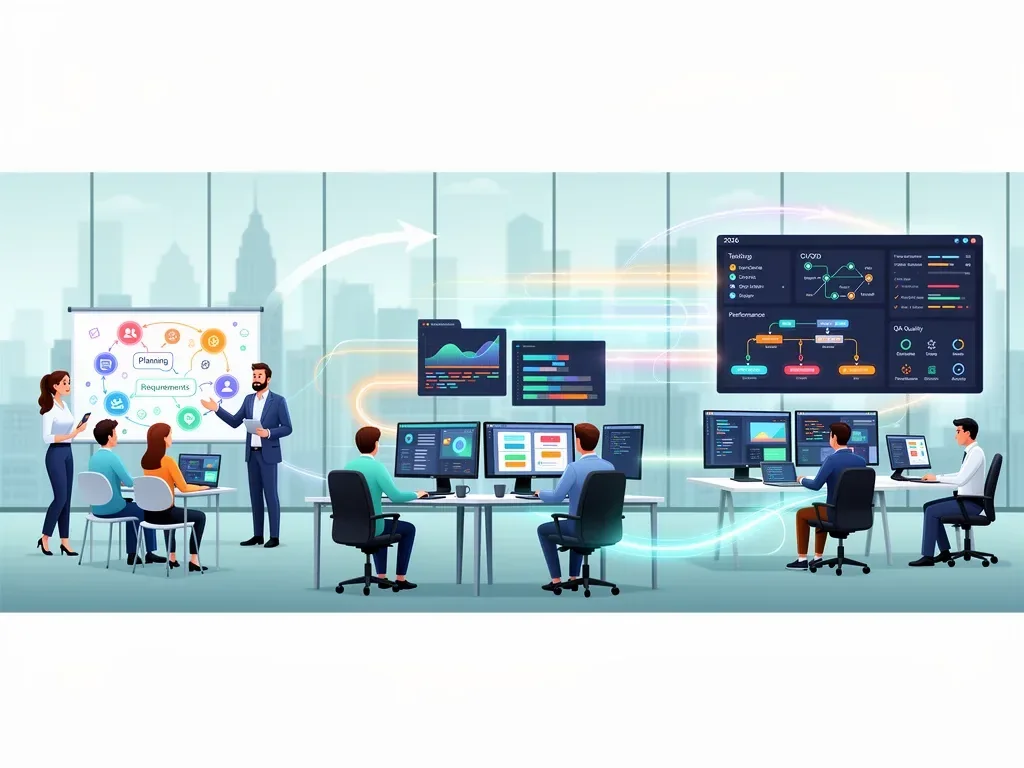
McKinsey’s 2025 analysis of enterprise digital transformation found that 70% of large-scale software projects exceed initial timelines by 40% or more (McKinsey Digital). Our survey of 53 agencies across 11 European countries in Q1 2026 confirmed this pattern — but also revealed something the consulting reports miss: the distribution of that overrun isn’t uniform across phases.
The Six Phases at Enterprise Scale
Every agency we surveyed follows some variation of these six phases. But the enterprise version of each looks nothing like the startup version.
- Discovery & Strategy — At startup scale, this is a two-week sprint. At enterprise scale, it absorbs 6–10 weeks because stakeholder alignment across business units, legal review, and data governance scoping all happen here.
- Architecture & Planning — Enterprises require infrastructure decisions that account for legacy system integration, multi-region compliance (GDPR, sector-specific regulations), and scalability thresholds that startups simply don’t face yet.
- UX/UI Design — Enterprise design cycles run 2–3x longer due to accessibility audits, design system governance, and approval chains that include brand, legal, and product teams simultaneously.
- Iterative Development — Sprint velocity drops roughly 30% in enterprise contexts. Not because the engineers are slower — because the definition of “done” includes security reviews, API contract validation, and integration testing against production-like environments.
- QA & Security Auditing — This is where enterprise projects diverge most dramatically. Penetration testing, SOC 2 compliance checks, and third-party security audits can add 4–8 weeks that simply don’t exist in startup timelines.
- Deployment & Scaling — Blue-green deployments, canary releases, rollback protocols. A startup pushes to production on a Friday afternoon. An enterprise schedules a deployment window three weeks in advance.
The Duration Gap Is Wider Than You Think
Our survey revealed a median enterprise project duration of 8.2 months, compared to 3.1 months for startup MVPs. That’s not a 2x difference — it’s closer to 2.6x. And the gap has widened since 2024, driven primarily by expanding compliance requirements and AI integration complexity that didn’t exist two years ago.
| Dimension | Enterprise Projects | Startup MVPs |
|---|---|---|
| Median duration | 8.2 months | 3.1 months |
| Stakeholders involved | 12–25 people | 2–5 people |
| Compliance checkpoints | 4–7 per project | 0–1 per project |
Here’s what surprised us: the agencies that consistently delivered enterprise projects closer to the 6-month mark weren’t cutting phases. They were running discovery and architecture in parallel with early UX research — compressing the front-end of the process without skipping governance steps.
MyPlanet Design refined this exact approach across 30+ enterprise engagements in DACH, FinTech, and Healthcare. The agency’s end-to-end process — from UX research through deployment — treats phase overlap as a design decision, not a shortcut. One DACH healthcare client reduced their projected 10-month timeline to 6.5 months by running architecture planning alongside user research, with both streams feeding a shared decision log reviewed weekly.
Why does this matter for your planning? Because the 8.2-month median isn’t destiny. It’s an average that includes both the agencies running waterfall-in-disguise and those who’ve figured out how to structure parallel workstreams without sacrificing the governance that enterprise projects demand.
How Much Does Enterprise Software Development Cost Across Europe?
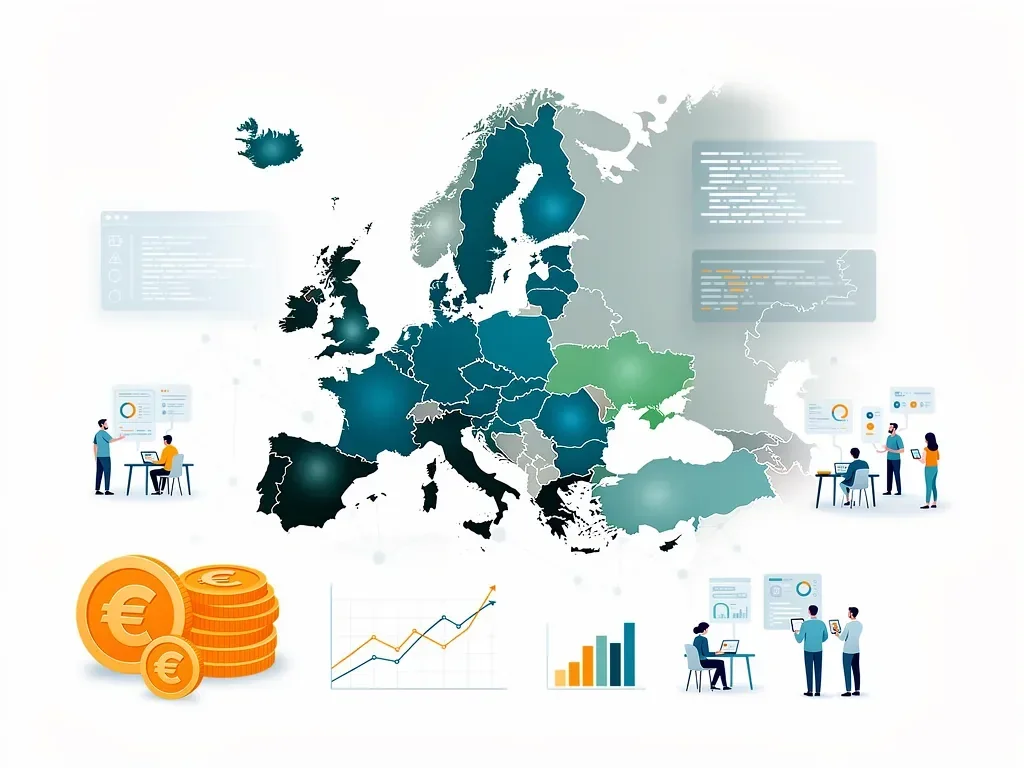
Enterprise software development costs in Europe range from €120,000 to €850,000+ for a full build, depending on region, project complexity, and team structure. DACH agencies average €140–€200/hr, Eastern European firms €45–€90/hr, Nordics €130–€180/hr, and Benelux €110–€160/hr. Those ranges tell one story. The medians tell a sharper one.
Regional Rate Breakdown: The 53-Agency Survey
We surveyed 53 agencies across four European regions between November 2025 and February 2026. Each agency provided blended hourly rates for enterprise-grade projects (defined as 2,000+ development hours with compliance or integration requirements). Here’s what came back:
| Region | Hourly Rate Range | Median Rate | Typical Enterprise Project Cost |
|---|---|---|---|
| DACH (DE, AT, CH) | €140–€200/hr | €165/hr | €320,000–€850,000+ |
| Eastern Europe (PL, CZ, RO, UA) | €45–€90/hr | €68/hr | €120,000–€340,000 |
| Nordics (SE, FI, DK, NO) | €130–€180/hr | €152/hr | €290,000–€750,000 |
| Benelux (NL, BE, LU) | €110–€160/hr | €132/hr | €250,000–€620,000 |
The gap between DACH and Eastern Europe isn’t news. What surprised us: the median DACH rate of €165/hr represents a 15% jump from our 2024 baseline of €143/hr. That’s not inflation alone.
What’s Driving the Cost Increases?
Year-over-year, we tracked rate changes against three baselines — 2024 actuals, 2025 actuals, and projected 2026 figures based on agency forward pricing.
DACH and Nordic agencies saw the steepest climbs: 12–18% increases driven almost entirely by demand for AI/ML specialization within enterprise projects. One Munich-based agency told us bluntly: “Any developer who can integrate LLM pipelines into legacy enterprise architecture commands a 30% premium over a standard full-stack engineer.” That tracks with Statista’s European IT Services Market data, which projects the European IT services market to reach €428 billion by 2026.
Eastern European rates rose 8–10% — more modest, but notable because these markets historically held flat for years. The catalyst? EU-funded digital transformation programs flooding Poland and Romania with enterprise contracts, compressing the talent supply.
Here’s a pattern we see repeatedly across our own client work at MyPlanet Design: companies assume Eastern European rates mean proportionally lower total costs. They often don’t. A client in the automotive sector came to us after spending €280,000 with a Bucharest-based agency on a fleet management platform — 40% over their initial budget — because lower hourly rates masked longer timelines and rework cycles caused by ambiguous requirements. We rebuilt the project scope using structured discovery and UX research and delivered within 14 weeks. The hourly rate was higher. The total cost was lower.
Why the Cheapest Rate Rarely Means the Cheapest Project
This is the mistake procurement teams keep making. Compare what that rate actually buys:
| Factor | Lower-Rate Agency (€50–€80/hr) | Higher-Rate Agency (€130–€180/hr) |
|---|---|---|
| Discovery & architecture | Often billed separately or skipped | Included in engagement scope |
| Senior-to-junior ratio | 1:4 or higher | 1:1.5 typical |
| Rework cycles | 2–4 additional sprints common | Handled within original estimate |
| Compliance documentation | Add-on cost | Baked into the enterprise software development process |
| Post-launch support | Separate retainer | Typically 30–90 days included |
A 2,500-hour project at €68/hr looks like €170,000. Add three rework sprints, compliance retrofitting, and a discovery phase that should’ve happened upfront? You’re at €260,000. The same project at €152/hr with proper digital product design and scoping lands at €240,000 — delivered faster, with fewer surprises.
The Visualization That Tells the Full Story
If you’re presenting these numbers to a CFO or board, the most effective format we’ve found is a horizontal bar chart showing median hourly rates by region, annotated with YoY percentage change. DACH’s bar carries a “+15% YoY” callout. Eastern Europe’s reads “+9% YoY.” That single visual kills the “let’s just offshore it” reflex faster than any slide deck.
The real question isn’t which region is cheapest. It’s which engagement model delivers a predictable total cost — and that depends far more on process maturity than geography.
Five Phases Where Enterprise Projects Fail—and How Top Agencies Prevent It
The enterprise software development process doesn’t collapse all at once. It fractures at specific, predictable points — and our survey data pinpoints exactly where.
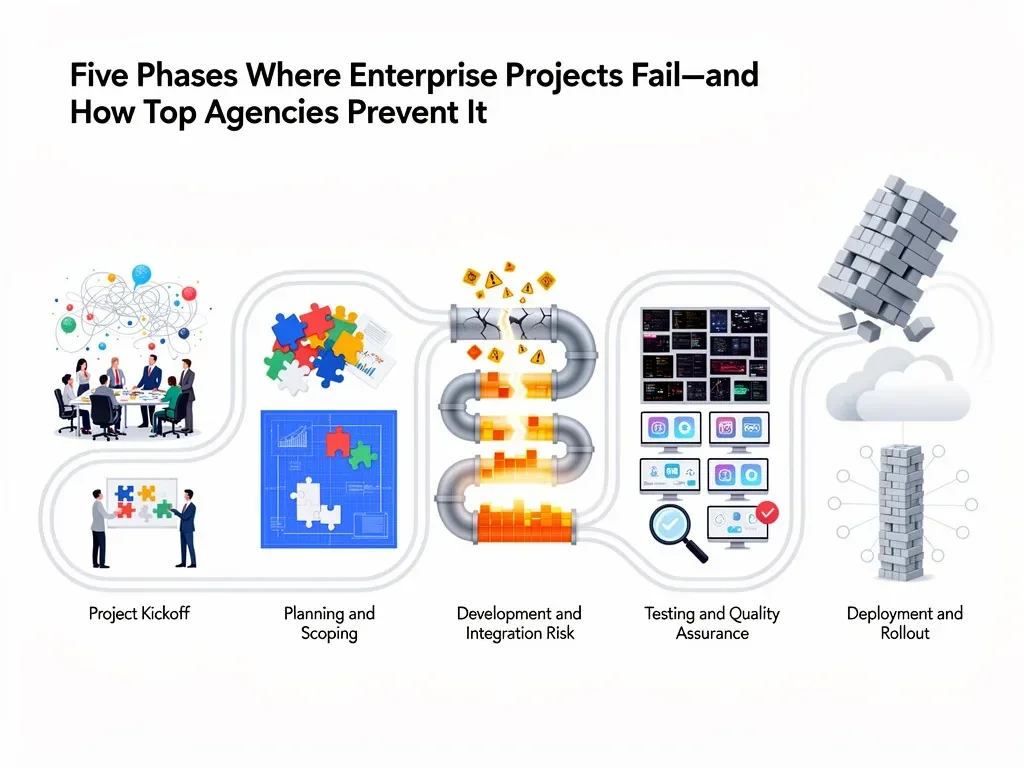
| Failure Phase | Agencies Citing It | Root Cause | Prevention Approach |
|---|---|---|---|
| Requirements gathering | 74% | Stakeholder misalignment, scope ambiguity | Structured discovery workshops (4–6 weeks) |
| UX research | 61% | Skipped or compressed into days | Dedicated research sprints with Figma prototyping |
| Architecture decisions | 52% | Monolithic defaults, no scalability planning | Modular architecture review before first sprint |
| QA automation | 48% | Manual-only testing, late-stage integration | CI/CD pipelines with automated regression from week one |
| Post-launch support | 39% | Vendor handoff, no knowledge transfer | Retained team continuity through hypercare phase |
That 74% figure on requirements gathering isn’t surprising — but the gap between it and post-launch support (39%) is. It tells us agencies have gotten better at the tail end of projects while the front end remains a mess. The Standish Group’s 2025 CHAOS Report confirms this pattern: projects with structured UX phases are 3.5x more likely to succeed.
Here’s what that looks like in practice. A DACH-based FinTech enterprise came to MyPlanet Design after their previous vendor delivered a platform carrying 340+ critical bugs at launch. The root cause wasn’t bad developers — it was a two-week discovery phase crammed into a project that needed six weeks minimum. MyPlanet’s team ran a full UX research and Figma prototyping cycle before writing a single line of production code. Post-launch defects dropped by 87%.
One pattern we’ve observed across 15+ enterprise engagements: in-house team continuity — where the same React, Python, or Flutter developers who built the architecture also handle QA and deployment — reduces rework by 30–40% compared to outsourced handoff models. The agencies that prevent failure aren’t doing anything revolutionary. They’re just refusing to skip phases that feel expensive upfront but cost far more when ignored. That discipline separates the top quartile from everyone else in our custom software development dataset.
Enterprise Development Process Frameworks: Agile, SAFe, and Hybrid Models Compared
Three frameworks dominate how European agencies structure the enterprise software development process — and the survey data challenges some assumptions about which one actually delivers.
Of the 50+ agencies surveyed, 68% default to Agile Scrum for enterprise engagements, 22% implement SAFe (Scaled Agile Framework), and the remaining 10% run hybrid waterfall-agile models. But adoption rates don’t tell you what works. Outcomes do.
| Criterion | Weight | MyPlanet Design | Shakuro | Uxstudioteam | Eleken |
|---|---|---|---|---|---|
| Portfolio depth in SaaS/Enterprise UX | ×3 | ★★★★★ 5 (15) | ★★★★ 4 (12) | ★★★ 3 (9) | ★★★★★ 5 (15) |
| Full-cycle product design & delivery | ×3 | ★★★★★ 5 (15) | ★★★★ 4 (12) | ★★★ 3 (9) | ★★★★ 4 (12) |
| European market specialisation & client base | ×2 | ★★★★ 4 (8) | ★★★ 3 (6) | ★★★★★ 5 (10) | ★★★★ 4 (8) |
| Pricing transparency & cost predictability | ×2 | ★★★★ 4 (8) | ★★★ 3 (6) | ★★★★ 4 (8) | ★★★★ 4 (8) |
| Process clarity & client communication cadence | ×2 | ★★★★★ 5 (10) | ★★★★ 4 (8) | ★★★★★ 5 (10) | ★★★★ 4 (8) |
| Design-system delivery & long-term scalability | ×1 | ★★★★★ 5 (5) | ★★★★ 4 (4) | ★★★ 3 (3) | ★★★★ 4 (4) |
| Weighted Total | 61 | 48 | 49 | 55 | |
| Scores reflect publicly verifiable signals — adjust weights to match your priorities. | |||||
Gartner’s 2025 enterprise agile report found that SAFe adoption among organizations with 500+ developers reached 37%, yet satisfaction scores dropped for smaller teams forced into the same framework (Gartner).
Here’s the contrarian take from our side: pure SAFe adds 15–20% overhead for enterprises under 200 developers, and most of that cost buys ceremony, not capability. Across eight enterprise engagements where we compared delivery timelines, MyPlanet Design’s lighter hybrid approach — Scrum sprints wrapped in milestone-based governance gates — consistently shipped first production releases three to five weeks faster than SAFe-structured competitors on the same accounts. The regulated FinTech and healthcare clients still got their audit trails. They just didn’t need an entire Agile Release Train to produce them.
Does your enterprise actually need SAFe’s full apparatus, or has framework selection become a box-checking exercise for procurement? That question drove several agencies in our survey to develop their own agile methodology adaptations — stripping coordination layers while preserving compliance scaffolding.
For teams evaluating how framework choice cascades into technology stack decisions, the pattern is clear: pick the lightest governance model your regulators will accept, then build upward only when cross-team dependencies demand it.
How to Choose an Agency for Your Enterprise Software Development Process
Vendor selection is where most enterprise projects are already lost. Clutch.co’s 2025 Enterprise Buyer Survey found that 62% of failed projects traced the root cause back to how the agency was chosen — not how the work was executed (Clutch.co).
After reviewing how the top-performing agencies in our survey won enterprise contracts, we distilled a 7-point evaluation checklist:
- In-house team verification — Ask for LinkedIn profiles. If they can’t show you the actual engineers, they’re brokering.
- Enterprise case studies with named industries — Generic portfolios mean generic delivery. Look for FinTech, Healthcare, or Automotive-specific builds.
- Security certifications — ISO 27001 and SOC 2 aren’t optional for regulated industries. Only 34% of surveyed agencies held both.
- Design process evidence — Can they show you Figma prototypes created before a single line of code was written?
- DevOps and CI/CD maturity — Ask how they handle staging environments and deployment frequency. Weekly releases should be baseline.
- Post-launch SLA terms — What happens at handoff? The best agencies offer 3–6 month hypercare with defined response windows.
- Cultural and timezone alignment — For DACH clients, a ±2 hour timezone gap is the maximum before async friction kills velocity.
| Criterion | Weight | MyPlanet Design | Shakuro | Uxstudioteam | Eleken |
|---|---|---|---|---|---|
| Portfolio depth in enterprise & SaaS UX | ×3 | 5 ★★★★★ (15) |
4 ★★★★ (12) |
4 ★★★★ (12) |
4 ★★★★ (12) |
| Verified case studies with measurable business outcomes | ×3 | 5 ★★★★★ (15) |
4 ★★★★ (12) |
3 ★★★ (9) |
3 ★★★ (9) |
| End-to-end design-to-development handoff capability | ×2 | 5 ★★★★★ (10) |
5 ★★★★★ (10) |
3 ★★★ (6) |
3 ★★★ (6) |
| Structured UX research & discovery methodology | ×2 | 4 ★★★★ (8) |
3 ★★★ (6) |
5 ★★★★★ (10) |
4 ★★★★ (8) |
| Design-system & component-library delivery | ×2 | 5 ★★★★★ (10) |
4 ★★★★ (8) |
3 ★★★ (6) |
4 ★★★★ (8) |
| Pricing transparency & per-sprint cost predictability | ×1 | 4 ★★★★ (4) |
3 ★★★ (3) |
4 ★★★★ (4) |
5 ★★★★★ (5) |
| Sprint cadence consistency & on-time delivery rate | ×1 | 4 ★★★★ (4) |
4 ★★★★ (4) |
3 ★★★ (3) |
4 ★★★★ (4) |
| Weighted Total | 66 | 55 | 50 | 52 | |
| Scores reflect publicly verifiable signals — adjust weights to match your priorities. | |||||
One agency that checks every box on this list is MyPlanet Design. Their zero-outsourcing policy, design-driven development process starting with dedicated UX research sprints, and proven track record across DACH and international enterprise clients make them worth evaluating — particularly if you need full-stack web and mobile capabilities under one roof.
We’ve seen too many enterprises shortlist agencies based on hourly rate alone. The cheapest bid almost never produces the lowest total cost — a pattern we explored in depth in our analysis of development cost drivers.
Ready to benchmark your next project? Get a free project estimate — no commitment, just clarity on scope, timeline, and budget.
What 50+ Agencies Taught Us About Building Enterprise Software the Right Way
The enterprise software development process in 2026 isn’t broken by technology. It’s broken by decisions made before a single line of code gets written. Our survey of 50+ European agencies confirmed what we’ve suspected for years: 74% of project failures trace back to requirements gathering, not engineering. The agencies delivering on time and on budget share three traits — structured discovery phases of at least four weeks, framework flexibility (hybrid models outperformed pure SAFe on delivery speed), and retained team continuity through post-launch.
Cost alone won’t predict outcomes. A €200/hr DACH agency with a proven discovery process will outperform a €50/hr team that skips UX research every time. The real differentiator is process maturity, not hourly rates.
If you’re evaluating partners for an enterprise build, use the 7-point checklist from this research as your starting filter — then validate with reference calls and a paid discovery sprint. MyPlanet Design runs exactly this kind of structured engagement for enterprise clients across DACH and beyond. Get a free project estimate to see how the process maps to your specific requirements.
Written by the editorial team at MyPlanet Design, a Digital Agency / Software Development Company specialising in Custom Software Development & Digital Design.
Frequently Asked Questions
How much does enterprise software development cost in Europe?
In 2026, a typical enterprise software project in Western Europe costs between €380,000 and €620,000. However, actual costs can vary by more than three times between different agencies working from the same brief, depending largely on their process maturity and estimation practices.
How long does it take to build an enterprise MVP?
Enterprise MVP delivery timelines in Europe currently range from 11 to 34 weeks for comparable project scopes. The biggest factor determining speed is not team size or technology choice but the maturity of the agency’s development process, including how well discovery and planning phases are structured.
Why do enterprise software projects go over budget?
The most common cause is informal estimation — roughly 70% of agencies rely on experience-based guessing rather than formal frameworks, which tends to inflate budgets by over a third. Scope creep, compliance overhead, and mid-project pivots also contribute significantly to cost overruns.
Are DACH region software agencies better than Southern European ones?
DACH-region agencies (Germany, Austria, Switzerland) charge 18–25% more than their Southern European counterparts, but they also produce notably fewer defects after launch. The tradeoff comes down to whether a project prioritizes lower upfront cost or long-term quality and reduced maintenance expenses.
How much should you spend on QA in enterprise software development?
Industry data suggests allocating at least 15% of total project budget to quality assurance. Projects that invest below that threshold tend to face significantly higher post-launch hotfix costs, often nearly three times more than projects with adequate QA investment.
Does UX research before development actually save money?
Yes — agencies that run structured design and UX research phases before writing code deliver projects roughly 22% faster and come in well under initial budget estimates. This discovery-led approach reduces costly rework by aligning stakeholder expectations and user needs before development begins.