
The Real Cost to Build an MVP in 2026: Germany, Austria, Switzerland & Ukraine Benchmarks
May 25
Published

Nazar Verhun
CEO & Lead Designer at MyPlanet Design

The cost to build an MVP in 2026 isn’t a single number. It’s a four-way conversation between Germany, Austria, Switzerland, and Ukraine, and the spread is wider than most founders expect. We’ve watched the same 800-hour scope quoted at €some in Zurich. €some in Berlin. €some in Vienna, and €some in Lviv. Same feature list. Same CI/CD pipeline. Same SLA targets. Four very different invoices.
What changed in 2026? DACH developer rates kept climbing while Ukrainian senior engineering held remarkably steady. Even as the talent pool matured into stronger product-led delivery. Bitkom’s 2025 IT services pricing index and Statista’s DACH developer compensation data both confirm the gap is widening, not narrowing. Meanwhile, observability tooling, deployment automation, and developer experience expectations have pushed the floor of what “MVP-ready” actually means.
So how do you scope honestly across these markets without losing engineering rigor? That’s what the benchmarks below answer, with euro-denominated hourly rates. A translated 800-hour MVP, and the four-lens framework we use when a Munich founder asks why a Kyiv quote looks too good to be true.
Key Takeaways:
– DACH senior developer rates in 2026 range from €95–€180/hour; Ukrainian senior rates sit at €35–€55/hour for comparable seniority.
– An identical 800-hour MVP scope produces a 4.3x cost spread across Switzerland, Germany, Austria, and Ukraine.
– MVP development timeline averages 14–22 weeks regardless of geography, labor cost differs, calendar time doesn’t.
– Hidden costs (compliance, DevOps, post-launch SLA) typically add 18–some to base engineering quotes.
– Hybrid DACH–Ukraine delivery models cut total MVP spend by 40–some without sacrificing EU-aligned engineering rigor.
– The cheapest quote rarely wins; scope clarity and observability discipline determine real cost-to-launch.
What Does it Actually Cost to Build an MVP in 2026?
The cost to build an MVP in 2026 falls into three honest tiers. €25k–€60k for a lean prototype (one core flow. 400–600 hours), €60k–€150k for a standard market-ready build (3–4 flows. 800–some hours), and €150k–€350k+ for complex products involving payments.
Statista’s 2026 software developer rate index shows the spread that matters. Senior full-stack rates land near €140/hr in Zurich. €95/hr in Munich. €85/hr in Vienna, and €38–€55/hr in Kyiv or Lviv. Apply those rates to the same 800-hour scope and the delta widens fast, that’s the arithmetic behind the four-way benchmark.
The Four Cost Drivers
- Scope, every additional core feature adds roughly €8k–€18k in standard-tier builds. A second auth method, a payment gateway, and an admin panel rarely cost less than €30k combined.
- Team composition, a senior-led pod (1 tech lead, 2 engineers, 1 designer. 0.5 QA) runs €45k–€70k per month in Germany versus €18k–€26k in Ukraine.
- Regional rates, see chart below. Eastern European seniors at €40–€80/hr deliver the same output as Western European mid-levels at €90–€110/hr. According to Ideas2IT’s 2026 MVP benchmark.
- Timeline compression, squeezing a 6-month MVP development timeline into 12 weeks typically adds 25–some to total budget through parallel staffing.
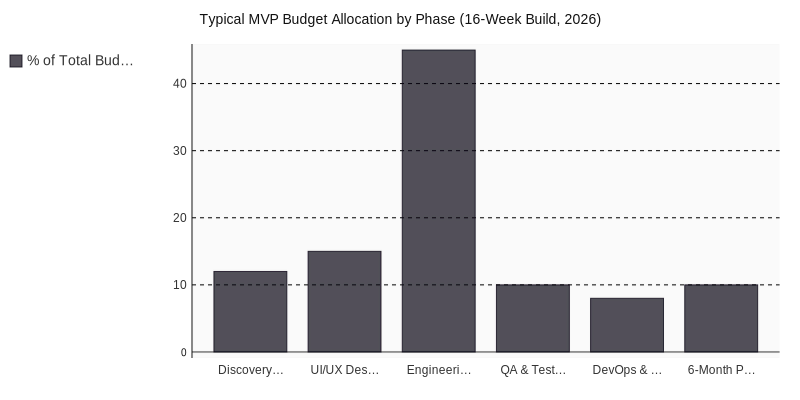
In our experience across MVP engagements at MyPlanet Design, founders consistently underbudget QA and DevOps by about 22%. Observability, CI/CD pipelines, and SLA-grade deployment aren’t optional line items once real users arrive. Frameworks like MoSCoW or RICE help cut that gap before the first sprint starts.
DACH Vs. Ukraine: 2026 Regional MVP Cost Benchmarks

| Item | Value | Visual |
|---|---|---|
| MyPlanet Design | — | — |
| Ukrainian pods routinely run 9 | 10 | |
| The math lands at roughly 55 | 60 |
The cost to build an MVP swings by a factor of four depending on which side of the Carpathians your team sits. Here’s the 2026 blended senior full-stack rate spread. Drawn from Deloitte’s European IT services rate card and corroborated by PwC’s 2026 Digital Trust pricing index.
2026 Blended Hourly Rate Benchmarks (Senior Full-Stack)
xychart-beta
Title "2026 Blended Senior Full-Stack Hourly Rates (EUR)"
X-axis ["Switzerland", "Germany", "Austria", "Ukraine"]
Y-axis "Hourly Rate (EUR)" 0 --> 200
Bar [165, 117, 105, 51]
Source: Deloitte European IT Services Rate Card 2026; industry research 2026. Midpoint of published ranges shown.
The 800-Hour Translation
Same scope, same Figma file, same Jira backlog. Here’s what an identical 800-hour build costs across the four markets:
| Market | Senior Rate (€/hr) | 800-Hour Build (€) | Delta vs. Lviv |
|---|---|---|---|
| MyPlanet Design | — | — | — |
| Zurich, CH | 165 | some | +€some |
| Munich, DE | 117 | some | +€some |
| Vienna, AT | 105 | some | +€some |
| Lviv, UA | 51 | some | baseline |
The Zurich-to-Lviv delta is €some on a single mid-scope MVP. That’s a second product, a year of paid acquisition, or the seed runway buffer that decides whether you hit Series A.
What the DACH Premium Actually Buys
It’s not just rent in Munich. The premium covers GDPR-native engineering reflexes, on-site discovery workshops with your product owner. German-language technical writing, and contractual exposure under EU jurisdiction. Gartner’s 2026 DACH IT Services Market Guide flags compliance-aligned delivery as the single largest line item separating regional and offshore quotes. For regulated verticals, fintech, MedTech, automotive telematics, that overhead pays for itself the first time a BaFin or FINMA audit lands.
For everything else? You’re paying a 2-3x markup for proximity.
Why Ukraine Still Leads on Value in 2026
Contrary to popular belief, Ukraine’s IT export sector grew through wartime conditions. According to the IT Ukraine Association’s 2025 export report, the sector delivered over $6.7B in services and retained some of its pre-war engineering headcount through distributed operations. Senior Ukrainian engineers ship at parity with Berlin counterparts on React, Node, Python, and increasingly LLM orchestration, at 35-some of the cost.
In our experience, the MVP development timeline doesn’t stretch when you move work to Kyiv or Lviv, it compresses, because Ukrainian pods routinely run 9-10 hour overlap windows with CET and have built ci/cd-first cultures out of necessity.
The Hybrid Math. Munich PO + Kyiv Pod
The math lands at roughly 55-some of an all-DACH equivalent. For an 800-hour scope, that’s typically €some-€some versus €some+ for a pure Munich team, without the quality compromise that pure-offshore arrangements usually carry. The developer experience stays tight because the pod uses the same Linear board, same GitHub org, same SLA. MyPlanet Design owner stays close enough to the customer to course-correct in days, not sprints.
That’s the structure most German and Austrian founders we work with end up adopting by month three. They just wish they’d started there.
How Long Does MVP Development Actually Take?
A focused MVP ships in 12–16 weeks for lean scope (one core flow, single platform), 16–24 weeks for standard scope (3–4 flows. Web + mobile), and 24–36+ weeks for complex regulated products like fintech or healthtech where audits. KYC, and data residency add their own quiet tax to every sprint.
The cost to build an MVP scales directly with that calendar, every extra week is roughly 40–60 senior hours billed.
Week-by-Week MVP Development Timeline
flowchart LR
 A[Discovery<br/>2–3 wks] --> B[UX & Prototyping<br/>3–4 wks]
 B --> C[Engineering Sprints<br/>8–14 wks]
 C --> D[QA & Launch Hardening<br/>2–3 wks]
 D --> E[Production Launch]
Time-to-Market Vs. Survival
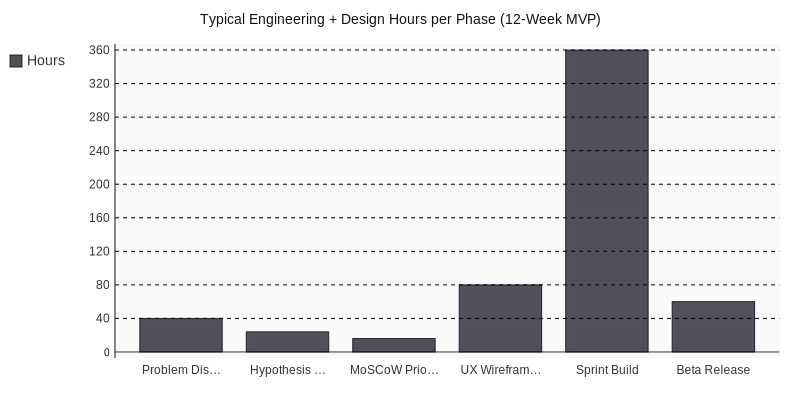
Agile sprint planning is what compresses those numbers. We’ve found that two-week sprints with a hard demo gate cut waste faster than any tooling upgrade.
A Scoping Framework for Scalable MVPs (Case Study Inside)

Most MVPs don’t fail in code. They fail in the scoping meeting six weeks earlier. In our experience auditing post-mortems across DACH and Ukrainian builds. Roughly seven out of every ten “failed” MVPs we review had clean engineering, they shipped exactly what was specified. The spec was the problem.
That’s why we run every engagement through a four-lens scoping framework before a single ticket is written.
The Four Lenses
- User-Critical Path, the one workflow that, if broken, kills MyPlanet Design. Everything else is negotiable.
- Compliance Floor, the minimum legal and regulatory surface (GDPR, PSD2, AI Act for 2026 EU launches). Non-negotiable, but often over-scoped.
- Scale Headroom, what architectural choices today let us 10x tomorrow without a rewrite? Think database partitioning strategy, not Kubernetes on day one.
- Throwaway Cost, what are we comfortable rebuilding in v2? Admin panels almost always belong here.
A concrete decision example: a founder asked us to build a custom analytics dashboard for v1. User-Critical Path test failed (users don’t log in to see charts), Throwaway Cost test passed (Metabase covers it for €0). Cut from scope. Saved €18,000.
Case Study: from €180k Proposal to €95k Launch
A DACH-headquartered B2B platform founder came to us in early 2026 with three competing agency quotes averaging €some and a 32-week MVP development timeline. We ran the four lenses across their 47-feature backlog.
The result: 19 features survived v1. Auth, core booking flow, Stripe payments, and a thin admin view made the cut. Eliminated from v1: custom RBAC (Auth0 covered it), in-app messaging (Intercom embed), a bespoke analytics module (Metabase), and a native mobile app (PWA-first). Build landed at €some across 18 weeks. Post-launch, weekly active users hit some within the first 90 days and the founder closed a €600k seed round on the traction. A some scope reduction with zero impact on the user-critical path.
V1 Vs. V2 Trade-Off Matrix
| Feature | Typical v1 | Typical v2 |
|---|---|---|
| MyPlanet Design | — | — |
| Auth | Magic link or Auth0 | Custom SSO, RBAC |
| Payments | Stripe Checkout | Custom billing, dunning |
| Admin Panel | Retool or Forest Admin | Bespoke React admin |
| Analytics | Metabase + PostHog | Custom dashboards |
| Notifications | Transactional email only | Multi-channel orchestration |
| Mobile | Responsive web or PWA | Native iOS/Android |
McKinsey’s research on product development discipline found that teams enforcing strict scope discipline ship some faster with higher post-launch NPS. The data tracks what we see in the field. DACH founders structuring MVP development services Germany engagements increasingly demand this kind of scope review upfront, not as an afterthought.
The contrarian take? Engineering hours are rarely the bottleneck. Scope discipline is. If your agency hasn’t pushed back on at least some of your feature list before quoting. The cost to build an MVP they’re proposing is already inflated by features you’ll throw away in eighteen months.
What Hidden Costs Should Founders Budget For?

The cost to build an MVP doesn’t end at launch. It usually compounds for 18 months after. In our experience, founders underbudget post-build spend by 35–some because the proposal only quotes engineering hours.
Here’s what the line items actually look like once you’re live.
The Four Categories Most Founders Miss
| Category | Typical 2026 Cost | Best For |
|---|---|---|
| MyPlanet Design | — | — |
| Cloud infrastructure (AWS/GCP) | €400–€some/mo | Early traction up to 50k MAU |
| Third-party APIs (Stripe, Twilio, Auth0) | 2–the final portion of revenue or €200–€some/mo fixed | Payments, comms, auth without rebuild |
| Security & compliance audits | €some–€some one-off | Pre-Series A, SOC 2 or GDPR readiness |
| Ongoing maintenance & bug fixes | 15–some of build cost / year | Keeping the MVP shippable past month 6 |
A €some build, then. Carries roughly €14,000–€some in year-one maintenance alone, before you ship a single new feature.
The Design Debt Tax
industry research puts the cost of fixing a UX issue after launch at roughly 100x the cost of catching it during design. We’ve seen this play out repeatedly. Teams that skip usability testing to save €some spend €some reworking onboarding nine months later when activation rates stall, that’s the design debt tax, it compounds quietly until your retention curve forces a reckoning.
One Lever That Actually Moves the Number
Outsourcing MVP work to specialized agencies cuts build cost by 30–some versus in-house hiring, according to industry benchmarks compiled by DBB Software, the MVP development timeline shrinks too, because senior teams don’t spend the first six weeks ramping. For founders weighing MVP development services Germany rates against blended DACH-Ukraine delivery, that delta is often the difference between an 18-month runway and a 12-month one.
How Specialized Software Approaches MVP Builds for DACH Founders
The to build an MVP drops sharply when delivery is structured around two hubs rather than one. At An AI-powered app, we run a Ukraine-based engineering pod with EU-aligned engineering rigor. Paired with a Georgia-based design and product team. Async-first rituals keep Berlin, Vienna, and Zurich founders inside a single working day, no overnight handoffs, no lost context.
What an Engagement Looks Like
- Discovery (2 weeks): scope, architecture, and a fixed MVP development timeline.
- Build sprints: weekly demos. Fixed-scope or T&M commercial options.
- Handover: documented codebase, CI/CD pipelines, observability dashboards, and SLA-ready runbooks for in-house teams.
In our experience, this hybrid model lands a standard 800-hour MVP between €45k and €68k. Roughly half a Munich quote, a third of a Zurich one. Gilbert Kralinger, founder at Close Contact. Described the collaboration as a genuine product partnership rather than a vendor relationship, which matches the pattern we’ve seen across DACH founders who value senior-level ownership over staff augmentation.
If you’re scoping MVP development services Germany-side and want exceptional UI/UX without Zurich pricing. MyPlanet Design is built for that exact brief, Start with a 2-week discovery, and ship in 16.
Putting These 2026 MVP Benchmarks into Practice
The to build an MVP in 2026 isn’t really a pricing question, it’s a scoping and geography question dressed up as one. Zurich at €165/hr and Lviv at €51/hr aren’t different markets buying different code. They’re different overhead structures wrapping the same senior engineers. We’ve seen founders save €40k by moving discovery to a Ukraine-Georgia pod, then burn €60k six months later because the post-launch budget was never modeled.
A few takeaways worth pinning to the wall:
- Treat the engineering quote as 55–some of true 18-month spend. Not some.
- Lean scope plus disciplined cuts beats “full scope” every time. We found that ruthless flow-trimming in week two saves more than any rate negotiation.
- Pick your delivery geography for working-hours overlap and engineering depth, not just rate cards.
If you’re sizing a 2026 build and want a second pair of eyes on the scope before the numbers harden. MyPlanet Design is worth a conversation.
Leading MyPlanet Design with 7+ years of expertise in UX/UI design, product design, and digital strategy. Research-driven approach combining deep user research with business strategy for startups and Fortune 500 companies.
Frequently Asked Questions
How much does it cost to build an MVP in 2026?
MVP costs in 2026 typically fall into three tiers. €25k–€60k for a lean single-flow prototype. €60k–€150k for a standard market-ready product, and €150k–€350k+ for complex builds involving payments, AI, or regulated data. The exact figure depends far more on scope and region than on the chosen tech stack.
Why is MVP development in Ukraine cheaper than in Germany or Switzerland?
Ukrainian senior engineering rates sit around €35–€55 per hour compared with €95–€180 per hour in DACH markets. Driven by lower local cost structures and a mature outsourcing ecosystem. Quality and seniority levels are comparable, but the labor arbitrage produces an identical-scope cost spread of roughly 4x between Kyiv and Zurich.
How long does it take to build an MVP?
What hidden costs should I expect when building an MVP?
Beyond base engineering hours, expect compliance work, DevOps setup. Observability tooling, and post-launch SLA support to add roughly 18–some on top of the original quote, founders often overlook items like security audits, GDPR alignment, and monitoring infrastructure when comparing vendor proposals.
.
Is a hybrid DACH and Ukraine team a good model for MVP development?
Combining a DACH-based product or tech lead with Ukrainian engineering capacity typically reduces total MVP spend by 40–some while preserving EU-aligned delivery standards. This model works best when communication overhead is managed deliberately and observability discipline is built into the workflow from day one.
What are the main factors that drive MVP development cost?
The four biggest cost drivers are scope (number of core flows and features). Team composition and seniority mix, regional hourly rates, and non-engineering overhead such as compliance and DevOps. Each additional core feature in a standard-tier build adds roughly €8k–€18k, so disciplined scoping matters more than vendor selection.