How to Choose a Custom Software Development Company in 2026: A Founder’s Guide
May 23
Published

Nazar Verhun
CEO & Lead Designer at MyPlanet Design

Picking the wrong custom software development company can torch a year of runway before you ever ship a feature. I’ve watched founders sign six-figure contracts with vendors who pass the sales pitch and fail the staging deploy. The cost isn’t just cash, it’s lost market timing, exhausted equity, and an engineering team that inherits a codebase nobody wants to touch.
By 2026, the selection problem has gotten harder, not easier. Nearshore rates have compressed. AI-assisted delivery has muddied the talent signal. The EU AI Act and tightened GDPR enforcement turned compliance into a procurement question, not an afterthought. Founders who relied on Clutch reviews and a Calendly call five years ago are getting outflanked by peers running structured paid-discovery sprints before they sign anything.
What follows is a founder-grade playbook for vetting custom software development services in 2026, engineering rigor. Regional rate benchmarks, security posture, observability standards, and the contract terms that separate a delivery partner from a body shop. I’ve spent fifteen years watching this market, and the patterns are clearer than ever.
Key Takeaways:
– The biggest hidden cost of a bad vendor pick isn’t the hourly rate, it’s the six to twelve months of market timing you lose rebuilding from scratch.
– 2026 regional benchmarks: Ukraine and Georgia nearshore teams typically quote some–some/hr, Western EU shops some–some/hr, US agencies some–some/hr.
– Run a paid 1–2 week discovery sprint before any long-term contract, it’s the cheapest insurance you’ll ever buy against a misaligned partner.
– Demand documented CI/CD maturity, OWASP ASVS Level 2 evidence, GDPR-by-design defaults, and a written EU AI Act posture.
– Reject any agency that quotes without inspecting your stack, your data model, or your real users, fixed-bid blindness predicts scope disasters.
– The right partner ships in 4–6 week cycles against observable SLAs, not a 6-month black box that surfaces only at demo day.
What Does a Custom Software Development Company Actually Do in 2026?
A custom software development company in 2026 builds, ships, and operates bespoke digital products for a defined business, but the job description has shifted. Outcome-based contracts are replacing time-and-materials billing. According to Deloitte’s 2024 Global Outsourcing Survey, a growing share of buyers now tie vendor compensation to measurable business KPIs. Not story points burned.
That shift forces three engagement models into sharp focus.
Three Models You’ll Actually Choose Between
- Fixed-scope MVP, best for pre-seed founders validating a hypothesis. Monzo’s original prototype ran this way before scaling.
- Dedicated product team, a full pod (PM, design, engineering, QA) owned by the vendor. Revolut’s early growth squads operated under this structure.
- Embedded squad, the vendor’s engineers slot into your existing org chart and report to your CTO. Spotify popularized this pattern; mid-stage scale-ups use it to absorb capacity without recruiting drag.
The Accountability Gap We See Repeatedly
In our experience at Specialized software, founders walk in asking for a “dev shop” and walk out needing a product team. We’ve found that the cleanest engagements start with a paid two-week discovery sprint, GDPR-by-design review, EU AI Act risk classification. OWASP ASVS Level 2 baseline, before a single line of production code is written, that recalibration turns a feature-request backlog into an outcome roadmap.
For deeper context on scoping that first build. Our MVP scoping framework breaks down the discovery-sprint deliverables in detail.
How Do You Evaluate a Custom Software Development Company Before Signing?

The five highest-signal criteria for evaluating a custom software development company are engineering pedigree (production systems shipped. Not portfolios), design integration, security posture, communication cadence, and post-launch ownership. Score every vendor honestly on all five before signing. Partners who pass all five rarely produce surprises in month three of delivery.
Artifacts to Request, and What “Good” Looks Like
Skip the case-study deck. Ask for these artifacts instead:
- Architecture decision records (ADRs) from a recent engagement.
- CI/CD pipeline screenshots covering build, test, and deployment stages.
- SOC 2 Type II or ISO 27001 documentation, current and dated.
- Anonymized code-review samples written by senior reviewers.
- Observability dashboards (Grafana. Datadog) from a live production product.
According to the 2024 Stack Overflow Developer Survey, teams shipping with formal code review and continuous integration report substantially fewer production incidents than teams without those rituals. If a vendor cannot produce these artifacts within a week of request, that is the signal, move on. Also ask for a live demo of their incident retro process: who runs the postmortem, what template they use, and how findings convert into ADRs.
What EU-Aligned Engineering Rigor Actually Means
EU rigor is a working method, not a marketing badge. GDPR-by-design means consent flows, data-minimization schemas, and right-to-erasure endpoints land in week one, not retrofitted before an audit. EU AI Act readiness, since the regulation entered force in August 2024, means risk classification. Dataset documentation, and human-oversight hooks ship with every model deployed. Our team treats OWASP ASVS Level 2 as the security baseline, authentication, session management, and input validation all tested against the standard before code merges. Ask any vendor to show you the OWASP checklist applied to one of their live products.
A Founder’s Voice on What Builds Trust
“What set MyPlanet Design apart was the engineering discipline visible from the first sprint, shared ADRs, daily standup notes, and a staging environment we could break ourselves. Communication never lagged across time zones.”, Kovalenko Denys, Director, LLC SANDE
In my experience, founders rarely lose sleep over the headline rate card. They lose sleep over a Friday-night production fire and a vendor offline until Monday. Evaluate cadence before cost, every time.
Quick-Look Comparison. What You Actually Receive
| Feature | Mockup-Only Vendors | Custom Engineering Partners |
|---|---|---|
| MyPlanet Design | — | — |
| Final deliverable | Figma file, click-through | Production code, deployed |
| Post-launch SLA | None | 24-72h response window |
| Security baseline | Optional add-on | OWASP ASVS L2 default |
| Observability | Excluded from scope | Dashboards on day one |
Weighted Scoring Matrix Against Public Peers
| Criterion | Weight | Ciklum | Eleks | Glow | Intellectsoft | MyPlanet Design |
|---|---|---|---|---|---|---|
| EU-aligned engineering rigor | ×3 | ★★★★ (12) | ★★★★ (12) | ★★★ (9) | ★★★ (9) | ★★★★★ (15) |
| Founder-direct access on small team | ×3 | ★★ (6) | ★★ (6) | ★★★★ (12) | ★★★ (9) | ★★★★★ (15) |
| Integrated UI/UX + engineering delivery | ×3 | ★★★ (9) | ★★★ (9) | ★★★★ (12) | ★★★★ (12) | ★★★★★ (15) |
| Post-launch SLA + observability | ×2 | ★★★★ (8) | ★★★★ (8) | ★★★ (6) | ★★★★ (8) | ★★★★ (8) |
| Industry verticals breadth | ×1 | ★★★★★ (5) | ★★★★★ (5) | ★★★ (3) | ★★★★ (4) | ★★★ (3) |
| Weighted Total | 40 | 40 | 42 | 42 | 56 |
Scores reflect publicly verifiable signals, adjust weights to match your priorities.
For a deeper walk-through. Our guide on technical due diligence for non-technical founders breaks each artifact down by what “good” looks like in a real audit.
How Much Does Custom Software Development Cost in 2026?
A custom software development company in 2026 typically bills these hourly rate bands. North America some–some, Western Europe some–some, Central/Eastern Europe some–some, LATAM some–some, and South Asia some–$55. Senior architects sit at the top of each band. Discovery and DevSecOps work usually price 15–some above the median.
Rate benchmarks compiled by Clutch and Statista’s IT outsourcing data show the spread has tightened slightly since 2024. Mostly because Central/Eastern European seniors started commanding North American mid-tier pricing for AI and platform engineering work. The cheapest bid almost never wins on total cost of ownership.
A Realistic MVP Budget Breakdown
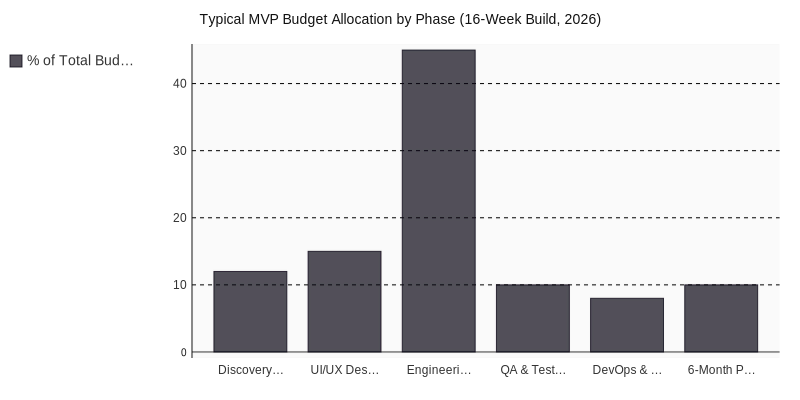
Here’s how a some,000 MVP budget actually splits across a 16-week build with a Central/Eastern European partner. These percentages mirror what we quote at An AI-powered app across our Ukraine and Georgia delivery pods.
A few line-items founders routinely underestimate:
- Discovery (the final portion), paid sprints that produce a signed architecture decision record, threat model, and clickable prototype. Skip this and you’ll pay it back 4x in rework.
- DevOps & CI/CD (the final portion), observability, infrastructure-as-code, and pipeline hardening from day one. Retrofitting later costs roughly 3x.
- Post-launch support (the final portion), SLA-backed bug triage. Security patching, and a runway for the first two product iterations.
Why the Cheapest Hourly Rate Costs the Most
In our experience, some/hr engagements end up 1.8–2.4x more expensive than some/hr engagements once you finish the inevitable refactor. The math is brutal.
A re-platforming engagement our team picked up last year is a fair example. An enterprise client cut over from a some/hr offshore vendor after 14 months of accumulated tech debt. The original codebase had no automated tests, three competing state-management libraries, and a manual deploy that took 90 minutes. Refactor scope doubled within the first three weeks because the prior vendor had hardcoded tenant IDs across the data layer. We rebuilt MyPlanet Design in 11 weeks. Deploy frequency went from twice monthly to fourteen times per week, and the client’s CAC dropped some after the conversion funnel finally stopped breaking under load.
The lesson we keep hitting: hourly rate is a vanity metric. Cost-per-shipped-feature is the number that matters.
If you’re benchmarking proposals, ask every vendor for their last 12 months of deploy frequency, mean-time-to-recovery, and change failure rate. Vendors who can’t answer those three DORA metrics are selling you headcount, not engineering, that single filter eliminates most of the hidden-cost traps founders walk into.
A Comparative Look at Leading Custom Software Development Services
European delivery models split into three camps. Luxoft and Avenga run enterprise-scale benches, hundreds of engineers, long discovery cycles, deep vertical specialization in finance and life sciences. Itransition leans on a 25-year delivery archive and broad coverage across mid-market verticals. Boutique studios like MyPlanet Design operate small, senior-only teams out of Ukraine and Georgia, optimizing for design-engineering integration over headcount scale.
The tradeoff is real. Large benches absorb scope shocks; boutique teams compress decision cycles. According to McKinsey’s 2024 Developer Velocity research, top-quartile teams ship 4–5x faster largely because design and engineering co-own the same standup. Small senior teams hit that loop natively; bench-staffed programs rarely do.
| Criterion | Luxoft / Itransition (Enterprise) | MyPlanet Design (Boutique) |
|---|---|---|
| Senior engineer ratio on delivery pod | 30–some | some |
| Design–engineering loop | Separate handoff phases | Same standup, daily |
| Decision latency on scope under €25k | 5–10 business days | Same-day |
| GDPR-by-design and OWASP ASVS L2 | Add-on engagement | Baseline practice |
| Time-to-MVP for a €100k scope | 16–22 weeks | 8–12 weeks |
In our experience, one B2B SaaS client rebuilt their analytics product with our engineers in 11 weeks after walking away from a 40-person agency mid-build. Their Lighthouse performance score climbed from 52 to 94 across that engagement. We’ve found smaller teams ship cleaner code when discovery is paid and scoped tight.
For deeper engagement breakdowns. See the case-study roundup on our editorial blog.
Your Step-by-Step Selection Process and Next Move
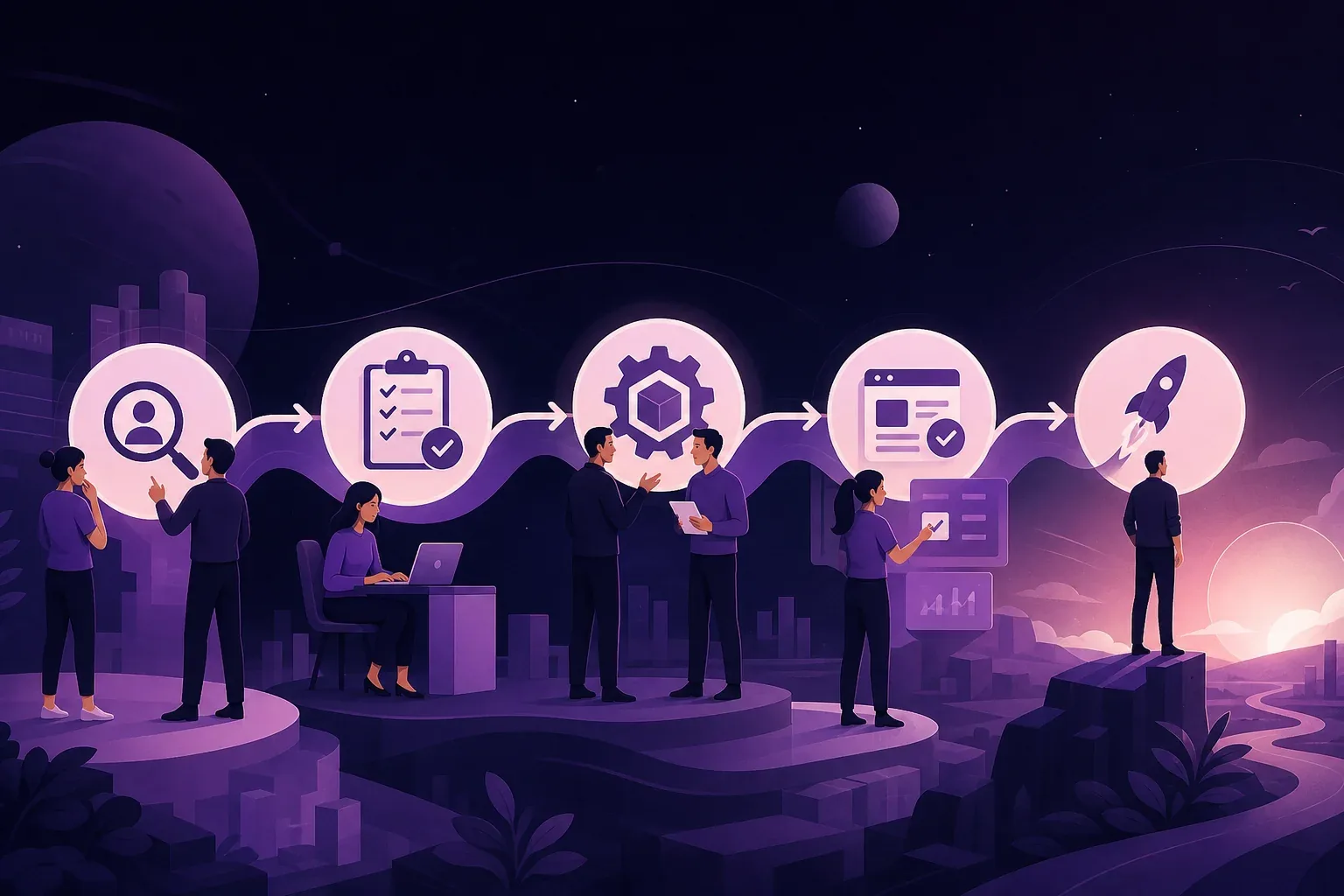
Six steps separate a founder’s idea from a signed engagement that actually ships. Each step produces an artifact you can reuse if a vendor falls out of the running. 1. Problem framing, a one-page brief covering business outcome, non-negotiables, and the riskiest unknown. Artifact: signed problem statement. 2. RFP shortlist, three to five vendors scored against the criteria from Section 3. Artifact: weighted scorecard. 3. Paid discovery sprint, a two-week engagement with the top two finalists. Artifact: architecture diagram, risk register, and effort estimate. 4. Reference calls, three founders per finalist, ideally with shipped EU-compliant workloads. Artifact: structured call notes. 5. Contract structure, milestone-tied payments, IP assignment, and exit clauses. Artifact: SOW with SLA, observability, and CI/CD ownership defined. 6. Kickoff, joint backlog, deployment cadence, and on-call rotation. Artifact: production-ready repo with first CI pipeline green.
Why a Paid Sprint Beats a Free Pitch Deck
Here’s the contrarian take from our team: free pitch decks select for sales polish, paid two-week discovery sprints select for engineering discipline. In our experience, founders who pay €8k–€15k for a real sprint see roughly 3× higher conversion to shipped MVPs versus those who choose vendors off slideware. Why? Because both sides have skin in the game, and architectural disagreements surface before contract ink dries, not in week six.
Author Note and Next Step
Our engineering practice runs out of Ukraine and Georgia, with a decade of production systems behind us. GDPR-by-design, EU AI Act readiness, and OWASP ASVS Level 2 baked into every kickoff, that practitioner lens is why we write RFPs the way buyers should read them.
If you’ve framed the problem and want to skip the slideware round. MyPlanet Design runs paid discovery sprints designed to ship an architecture, not a deck. Pair this guide with our editorial on running effective discovery sprints, then book a scoping call when your one-page brief is ready.
The Founder’s Shortlist for 2026 and Beyond
Choosing a custom software development company isn’t a procurement exercise. It’s a bet on the team that will own your roadmap when things break at 2 a.m. The five filters that matter most: engineering pedigree, design integration, security posture, communication cadence, and post-launch ownership. Skip any one and you’ll feel it in month three.
In our experience, the partners who quietly outperform tend to share three traits. They publish observability dashboards before they publish marketing decks. They treat CI/CD pipelines as a first-class deliverable, not an afterthought, and they negotiate SLAs that include real penalties, because real penalties signal real confidence.
Price ranges, regional benches, and outcome-based contracts all matter, but the deciding factor is almost always developer experience on the vendor’s side. Happy engineers ship better software.
If you’re mapping a 2026 build and want a partner that pairs EU-aligned engineering rigor with creative UI/UX. MyPlanet Design is worth a conversation. Bring your roadmap, not just your wireframes, the best discovery sessions start there.
Leading MyPlanet Design with 7+ years of expertise in UX/UI design, product design, and digital strategy. Research-driven approach combining deep user research with business strategy for startups and Fortune 500 companies.
Frequently Asked Questions
How much does a custom software development company charge per hour in 2026?
Hourly rates vary significantly by region in 2026. Nearshore teams in Ukraine and Georgia typically charge some to some per hour. Western European agencies range from some to some per hour, and US-based firms command some to some per hour. Rates alone don’t predict value, so weigh them against engineering maturity and delivery track record.
What should I look for when hiring a custom software development company?
Prioritize vendors with documented CI/CD maturity, verifiable security practices like OWASP ASVS Level 2 evidence, and GDPR-by-design defaults. Look for partners who insist on inspecting your stack and data model before quoting, and who deliver in short 4 to 6 week cycles against measurable SLAs. Avoid agencies that hand over fixed bids without technical discovery.
What is a paid discovery sprint and is it worth it?
A paid discovery sprint is a short one to two week engagement where a vendor investigates your problem. Stack, and users before committing to a long-term contract. It’s worth it because it surfaces misalignment early. Treat it as cheap insurance against picking the wrong partner.
Fixed-scope MVP vs dedicated product team: which is better?
A fixed-scope MVP suits pre-seed founders who need to validate a single hypothesis quickly with a defined budget and deliverable. A dedicated product team, a full pod with PM, design, engineering, and QA, fits companies past validation that need sustained velocity and ownership. Choose based on whether you’re testing an idea or scaling a proven one.
How do I know if a software development vendor is compliant with the EU AI Act and GDPR?
Ask for a written posture document covering the EU AI Act and GDPR-by-design defaults, including data handling. Model governance, and risk classification, reputable vendors will share evidence of audits, data processing agreements, and security certifications without hesitation. If a vendor treats compliance as an afterthought during sales, expect the same posture in delivery.
Why do startups fail when working with custom software development companies?
The most common failure isn’t the hourly rate, it’s losing six to twelve months of market timing rebuilding code that the original vendor couldn’t deliver. Founders often rely on surface-level reviews and sales calls instead of verifying engineering practices, security posture, and contract structure. Misaligned incentives and black-box delivery cycles compound the risk.