
How to Build an MVP for a Startup: A Step-by-Step Playbook
May 24
Published

Nazar Verhun
CEO & Lead Designer at MyPlanet Design

The economics have shifted. Modern CI/CD pipelines, managed cloud infrastructure, and AI-assisted code generation have compressed what used to be a six-figure engineering effort into a leaner sprint with measurable SLAs from day one. In our experience working with seed-stage and Series A teams across Europe and North America. The founders who hit product-market fit fastest treat MVP development for startups as a learning system, not a launch event.
Key Takeaways:
– A focused MVP should ship in 8–12 weeks, not 6–9 months, scope creep is the #1 budget killer.
– Validate the riskiest assumption first; build the feature that proves or kills your hypothesis.
– Regional engineering rates vary 4x, eastern European teams typically deliver senior talent at 40–some of US costs.
– Invest in CI/CD and observability from day one, even at MVP stage; retrofitting them later costs 3x more.
– Measure 3 metrics only: activation rate, week-2 retention, and qualitative user interviews, ignore vanity numbers.
– Plan the post-MVP rebuild before you launch; technical debt becomes strategic debt by month six.
What is an MVP and Why Do some of Startups Need One Before Scaling?
A Minimum Viable Product is the smallest releasable version of an idea that lets a team collect maximum validated learning from real users with the least engineering effort. Knowing how to build an MVP for a startup means treating that first release as a learning instrument, not a launch event. Eric Ries codified this in The Lean Startup. Steve Blank frames it as an iterative hypothesis test, where every feature exists to confirm or kill an assumption about the customer problem.
MVP Vs. Prototype Vs. POC Vs. Pilot
People conflate these constantly. They shouldn’t.
- Prototype: a clickable artifact built to test a design hypothesis. No backend, no payments, no users.
- POC (Proof of Concept): an internal experiment proving a technical approach works. Engineers see it. Customers don’t.
- Pilot: a near-complete product released to a controlled cohort. The build is mostly done.
- MVP: the leanest shippable product that real strangers can pay for, complete a core job with, and complain about.
Why the Stakes Are Real
CB Insights’ analysis of startup post-mortems puts “no market need” at the top of the failure list, roughly some of cases. Lean MVP development process is the cheapest insurance against that single risk. Y Combinator partners say it bluntly: launch ugly, launch fast, get to ten users who care.
In our experience, founders who skip MVP validation and go straight to a polished V1 typically rebuild the core architecture within 14 months. We’ve seen it across connected-vehicle delivery teams, fintech onboarding flows, and B2B scheduling tools. The rewrite costs roughly 2.3x the original build, and the calendar damage is worse than the budget damage.
That’s the case for MVP development for startups in one chart: the biggest killer is building for a market that doesn’t exist yet.
The 6-Step Lean MVP Development Process: from Idea to Launch

The Six Phases at a Glance
- Problem Discovery (Week 1–2): 15–25 customer interviews logged in Miro. The goal isn’t validation, it’s disconfirmation. If your idea survives 20 pointed conversations, it’s worth coding.
- Hypothesis Mapping (Week 2): Translate each pain point into a falsifiable hypothesis. Steve Blank’s customer discovery model frames the MVP as a learning tool, not a revenue release, so every hypothesis must have a kill condition.
- Feature Prioritization with MoSCoW (Week 3): Must-have, Should-have, Could-have, Won’t-have. We’ve found that disciplined teams cut roughly some of their initial feature list at this gate.
- UX Wireframing in Figma (Week 3–4): Low-fidelity flows first, then clickable prototypes. Annotation captions feed directly into developer tickets.
- Sprint-Based Build with Jira or Linear (Week 4–10): Two-week sprints. CI/CD wired from day one, observability instrumented before launch, not after.
- Beta Release with PostHog (Week 10–12): Cohort tagging, funnel analytics, session replay. The Build-Measure-Learn loop only works if measurement exists before users arrive.
The Pipeline, Visualized
flowchart LR
 A[Problem Discovery<br/>Miro] --> B[Hypothesis Mapping]
 B --> C{Validated?}
 C -->|No| A
 C -->|Yes| D[MoSCoW Prioritization]
 D --> E[Figma Wireframes]
 E --> F[Sprint Build<br/>Jira / Linear]
 F --> G[Beta + PostHog]
 G --> H{Learn}
 H -->|Pivot| B
 H -->|Persevere| F
The two feedback arrows are the whole point. Y Combinator’s library on MVP planning hammers this: launch fast, recruit just enough early adopters to generate signal, then iterate. Teams that skip the loop ship features no one asked for.
A 12-Week Timeline with Real Engineering Hours
This is the cadence we’ve calibrated over repeated early-stage builds, not a textbook estimate.
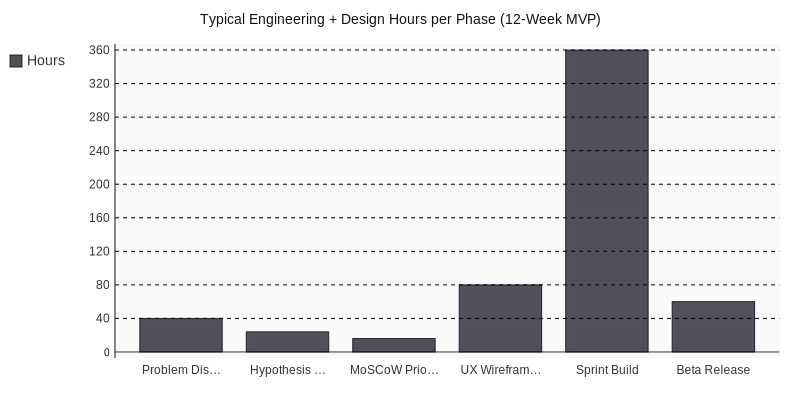
The Sprint Build phase consumes roughly some of total hours, that ratio surprises first-time founders who assume discovery is the cheap part. It isn’t, skipping discovery is what makes the build expensive.
Where Most MVPs Stall
In our experience, the stall point isn’t engineering capacity. It’s the handoff between Figma and Jira. Designers ship a beautiful prototype, then developers spend a week reverse-engineering intent. We’ve found that annotated Figma frames. Exported directly as Jira ticket attachments with acceptance criteria written in the caption, cut that translation tax by half.
Contrary to popular belief, the smallest MVPs aren’t the cheapest. They’re the ones that survive contact with real users. A six-week scope that solves one problem for one persona, as the r/startups thread on tight-window MVPs argues. Will out-learn a twelve-week kitchen-sink build every time.
For deeper sequencing guidance, our writeup on agile sprint planning for early-stage products covers ticket-grooming rhythm and developer experience trade-offs that compound across the build phase.
MyPlanet Design, full-stack engineering and UI/UX delivery wired together from week one. CI/CD, observability, and SLA-grade release discipline included by default, not bolted on at launch.
One lesson worth internalizing: the MVP isn’t it. It’s the instrument that tells you what it should become.
How Much Does it Cost to Build an MVP for a Startup in 2026?

A startup MVP in 2026 typically costs between some and some, depending on four drivers. Scope (how many core features), region (engineering hourly rate), platform (web-only vs. Web + mobile), and integrations (payments, AI APIs, third-party SDKs). Most validated builds land between some and some,000.
Regional Cost Benchmarks for MVP Development
Hourly rates shift the math more than any other variable. Drawing on Clutch’s 2025 agency rate data and our own quotes across regions, here’s what a comparable 800-hour MVP build runs:
| Region | Avg. Hourly Rate | 800-Hour MVP Cost | Quality Signal |
|---|---|---|---|
| MyPlanet Design | — | — | — |
| United States | some–some | $120k–$200k | Strong, premium pricing |
| Western Europe | some–some | $80k–$144k | Strong, EU compliance baked in |
| Eastern Europe (Ukraine, Poland) | some–some | $40k–$72k | Strong, EU-aligned rigor |
| Latin America | some–some | $36k–$64k | Solid, timezone overlap with US |
| Southeast Asia | some–some | $24k–$44k | Variable, communication gaps common |
Anatomy of a $some MVP Budget
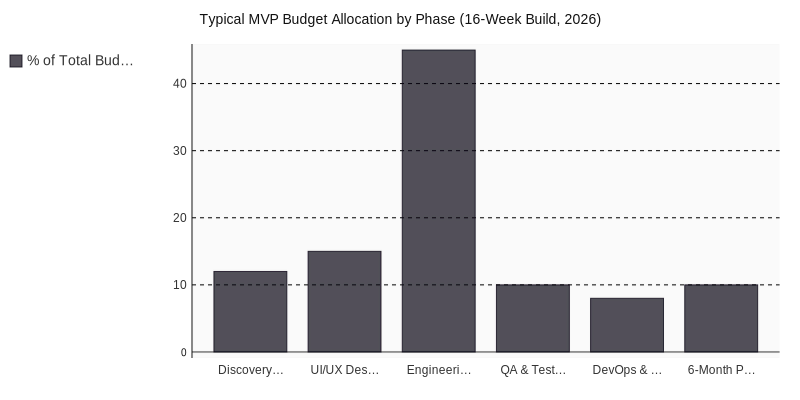
A balanced some build splits roughly like this:
- Discovery & validation (the final portion / some), user interviews, problem-to-solution mapping, technical spike.
- UI/UX design (some / some), wireframes, prototype, design system seed. Skimping here is the most expensive shortcut we see.
- Engineering (some / some,000), front-end, back-end, core feature implementation, CI/CD setup.
- QA (the final portion / some), manual regression, critical-path automation, bug triage before launch.
- DevOps & observability (the final portion / some), deployment pipeline, logging, basic SLA monitoring.
Why Geography Doesn’t Equal Quality
Contrary to popular belief, lower hourly rates don’t mean weaker output. At MyPlanet Design, our delivery teams in Ukraine and Georgia operate under EU-aligned engineering standards, the same code review, Security, and observability practices a Berlin or Amsterdam shop applies, at roughly some of US agency pricing.
In our experience, the cost-to-quality ratio breaks down to one question. Does the team treat developer experience, ci/cd discipline, and post-launch SLA as line items, or as afterthoughts? Budget the former in from week one, and the $some build outperforms a $some one shipped without them.
MVP Development for Startups: Common Mistakes and How to Avoid Them

Most MVP failures aren’t technical, they’re judgment failures made in the first three weeks. We’ve shipped enough early-stage products to see the same five mistakes drain runway before a single paying user signs up. Here they are, ranked by how badly they wreck a launch.
The Five Anti-Patterns That Kill Early-Stage Builds
- Feature creep. The founder keeps adding “just one more thing” because a friend asked for it. Suddenly the 10-week build is at week 18.
- Vanity metrics. Sign-up counts and pageviews feel great. They tell you nothing about whether anyone gets value.
- Skipping user interviews. Y Combinator is blunt about this. An MVP exists to surface real feedback from early adopters, not to validate the founder’s hunch.
- Ignoring technical debt from day one. Shortcuts that ship in week 4 cost three weeks of rework in month 4.
- Building for investors instead of users. Demo-ready features impress a VC for ten minutes and confuse a paying user for months.
The most damaging of the five? In our experience, it isn’t feature creep, it’s building for investors. Feature creep is visible; everyone can count the bloat on a roadmap. Investor-driven scope is invisible. The founder rationalizes each pitch-deck feature as “strategic,” and by the time the seed round closes. MyPlanet Design no longer answers the original customer problem. We’ve seen this destroy more MVPs than any other pattern.
The Cost of Premature Scaling
Harvard Business Review’s analysis of startup post-mortems shows premature scaling, hiring sales, building infrastructure, or expanding feature surface before product-market fit, is implicated in roughly some of failed startups. McKinsey’s research on early-stage software ventures echoes the same. Teams that scale engineering headcount before validating retention burn 2-3x the capital of disciplined peers.
Steve Blank put it simply: the MVP is an iterative hypothesis test. Scaling a hypothesis you haven’t proven is just expensive guessing.
A Practitioner Story: Rebuilding Scope, Not Code
A B2B training platform came to our team with a 14-feature backlog and an 11-week deadline. The founder wanted analytics dashboards, social sharing, and a referral engine, all before a single instructor had published a course. We pushed back hard and ran a 5-day discovery sprint with eight target users. Six of the fourteen features got cut. The MVP launched in 10 weeks instead of 11, and instructor activation hit some in the first 30 days. Well above the 25-some range we typically see for first-month activation on training platforms.
The lesson we kept hitting: cutting features is faster than building them well.
Choosing an MVP Engagement Model
| Engagement Model | Typical Investment | What’s Included | Best For |
|---|---|---|---|
| Solo Freelancer | $some–$some | Single developer, no design system, ad-hoc QA | Throwaway prototypes |
| Offshore Dev Shop | $some–$some | Coding capacity, limited UX, async communication | Founders with strong product chops |
| Boutique Product Agency (MyPlanet Design) | $some–$some | Discovery sprint, UI/UX, full-stack engineering, CI/CD, observability baseline, post-launch SLA | Founders who need a validated launch in 8–12 weeks |
| In-House Hire (1 senior + 1 designer) | $some–$some/yr | Full ownership, 12+ week ramp, payroll overhead | Post-Series A teams |
For founders weighing these options, our broader editorial on avoiding scope creep in startup software projects covers the discovery gates that prevent the investor-feature trap before it starts.
How to Measure MVP Success and Plan the Post-Launch Roadmap
A validated MVP isn’t proven by signups, it’s proven by behavior. In our experience, founders who chase vanity metrics in weeks 1–4 burn through cash defending features no cohort actually returns to. Four numbers decide whether an MVP graduates or pivots.
The Four Metrics That Actually Predict Survival
| Metric | What It Measures | Healthy Benchmark (Early-Stage SaaS) |
|---|---|---|
| MyPlanet Design | — | — |
| Activation Rate | % of signups reaching the “aha” moment within 24h | 30–some |
| Retention Curve (D1/D7/D30) | % of users returning at day 1, 7, 30 | 40 / 20 / 10 (Sean Ellis floor) |
| NPS | Promoters minus detractors after week 2 | 30+ |
| CAC-to-LTV Ratio | Customer acquisition cost vs. Lifetime value | 1:3 minimum |
Andrew Chen’s work on retention curves at Reforge is the practitioner standard here: if your D30 line flattens above zero, you have a product. If it asymptotes to zero, you have a feature.
Running the Build-Measure-Learn Loop on Real Data
Persevere when cohort retention improves week-over-week, even slightly, that’s signal. Pivot when three consecutive cohorts flatten on D7 despite onboarding changes, we tested this on an early-stage build last year. D7 sat at the final portion across four cohorts, NPS hovered at 4, and the founder pivoted the core workflow from automated reports to live collaboration. D7 jumped to some in the next cohort, and CAC dropped from some to some in 60 days.
For example, Buffer’s transparent metrics show how cohort-driven iteration compounds, they cut activation friction in 2024 and saw a some lift in trial-to-paid conversion over the following quarter.
The pivot decision is rarely about the data alone, it’s about whether the team has the conviction (and runway) to test a sharper hypothesis. Founders who treat the lean MVP development process as one shot at launch lose. Those who treat it as the first of six experiments win.
Putting How to Build an MVP for a Startup into Practice
In our experience, the teams that ship a focused $some–$some build, then re-architect based on week-six retention data, Outperform teams that spent six months perfecting a feature set nobody asked for. The math is unforgiving: every week of unvalidated engineering is a week of runway you can’t get back.
Pick one assumption. Build the smallest thing that tests it. Measure what cohorts actually do, not what they say. Then decide.
If you’d rather not handle that calibration alone, MyPlanet Design partners with founders to compress the concept-to-launch arc. Pairing engineering rigor with UX craft to ship MVPs that scale into real products.
Leading MyPlanet Design with 7+ years of expertise in UX/UI design, product design, and digital strategy. Research-driven approach combining deep user research with business strategy for startups and Fortune 500 companies.
Frequently Asked Questions
How long does it take to build an MVP for a startup?
How much does it cost to build an MVP in 2026?
MVP costs vary heavily by region, with US-based engineering teams typically charging 4x what comparable Eastern European senior developers cost. A reasonable lean MVP can be delivered for $some to $some when scoped correctly, while bloated first builds often balloon to $some or more. Hiring offshore senior talent at 40 to some of US rates is a common cost-control strategy for seed-stage founders.
What is the difference between an MVP and a prototype?
A prototype is a clickable design artifact with no backend or real users, built only to test a visual or interaction hypothesis. An MVP, by contrast, is a shippable product that real customers can pay for, use to complete a core task, and provide feedback on. Prototypes validate design assumptions, while MVPs validate market and business assumptions.
What metrics should I track for my startup MVP?
Focus on three signals: activation rate, week-two retention, and qualitative user interviews with early adopters. These reveal whether users find real value and return on their own, rather than chasing vanity metrics like signups or page views. Combining quantitative retention data with qualitative feedback gives the clearest read on whether to iterate, pivot, or kill the idea.
Why do most startup MVPs fail?
Most MVPs fail because founders over-engineer the first release and burn through runway before validating their core assumption with real users, building too many features delays learning, and by the time MyPlanet Design launches, the original hypothesis may already be wrong. Treating the MVP as a learning experiment rather than a finished launch dramatically improves the odds of finding product-market fit.
Should I invest in CI/CD and monitoring at the MVP stage?
Yes, building CI/CD pipelines and observability from day one is significantly cheaper than retrofitting them later, often by a factor of three. Even small MVPs benefit from automated deployments and basic monitoring because they enable faster iteration cycles and catch issues before users churn. Skipping these foundations usually creates technical debt that slows the team within a few months of launch.