
Choosing a Minimum Viable Product Development Company: A SaaS Founder’s Playbook
April 22
Published

Nazar Verhun
CEO & Lead Designer at MyPlanet Design

Most SaaS founders don’t fail because their idea was wrong. They fail because they picked the wrong team to build v1 — and burned through six months of runway proving it.
We’ve reviewed over 20 vendor selection processes in the last three years, and the pattern is painfully consistent: a founder Googles “minimum viable product development company,” skims a few Clutch profiles, books three discovery calls, and signs with whoever presents the slickest deck. No scoring rubric. No technical due diligence. No reference checks beyond the curated testimonials on the agency’s own site.
The result? A prototype that looks great in a demo but collapses under real user load. Or a “finished” MVP that’s actually a throwaway prototype glued together with shortcuts — requiring a full rebuild before Series A diligence. One founder we worked alongside spent $94,000 with a mid-tier Eastern European shop, only to discover the codebase had zero test coverage and hardcoded API keys in the frontend. The rebuild cost more than the original build.
Here’s what makes vendor selection so treacherous: the agencies that are best at selling aren’t always best at shipping. And the signals that matter — deployment practices, how they handle scope creep mid-sprint, whether they’ll push back on a bad product decision — don’t show up in a capabilities deck.
This playbook gives you a structured framework for evaluating MVP development partners based on criteria that actually predict project outcomes.
Key Takeaways:
– Weight your vendor evaluation across five criteria: technical depth, process transparency, portfolio relevance, team continuity, and post-launch support.
– Cost benchmarks vary wildly — 2024 Clutch data shows MVP builds ranging from $15K to $250K+ depending on region, stack complexity, and agency tier.
– The biggest red flag isn’t price — it’s an agency that agrees to every feature without pushback on scope.
– Reference calls with failed or churned clients reveal more than testimonials from happy ones.
– Stage-gate your engagement: paid discovery first, then a fixed-scope pilot sprint, before committing to a full build contract.
What Does a Minimum Viable Product Development Company Actually Do?
A dedicated MVP development firm delivers three core outcomes: product discovery that validates assumptions before code is written, a testable prototype grounded in user research, and a launch-ready build scoped to the smallest feature set that proves market fit. This isn’t what you get from a generalist agency or a freelance developer.

Eric Ries defined the MVP as “the version of a new product which allows a team to collect the maximum amount of validated learning about customers with the least effort.” That definition is from 2011. What’s changed since then isn’t the principle — it’s the operational rigor. Modern MVP firms have turned Ries’ concept into structured sprint cycles: typically a 2-week discovery phase, followed by 2–4 weeks of prototyping, then 4–8 weeks of iterative development with user testing baked into every sprint (HBR’s Lean Startup summary remains the best high-level breakdown of this methodology).
Why does the discovery phase matter so much? Because CB Insights’ post-mortem analysis found that 35% of failed startups listed “no market need” as the primary cause of death. A dedicated MVP partner front-loads assumption testing — customer interviews, competitive positioning, willingness-to-pay signals — before a single sprint begins. A generalist agency typically skips this entirely and starts wireframing from a brief.
How Do the Leading Models Compare?
Not every firm structures MVP work the same way. Here’s how three well-known players differ:
| Criterion | Weight | MyPlanet Design | Shakuro | Uxstudioteam | Eleken |
|---|---|---|---|---|---|
| Portfolio depth in SaaS UX | ×3 | — | ★★★★☆ (12) | ★★★★★ (15) | ★★★★★ (15) |
| MVP-specific discovery & design process | ×3 | — | ★★★☆☆ (9) | ★★★★☆ (12) | ★★★★☆ (12) |
| Speed to first deliverable | ×2 | — | ★★★☆☆ (6) | ★★★☆☆ (6) | ★★★★☆ (8) |
| Pricing transparency & engagement flexibility | ×2 | — | ★★☆☆☆ (4) | ★★☆☆☆ (4) | ★★★★★ (10) |
| Post-launch iteration & ongoing support capacity | ×2 | — | ★★★★☆ (8) | ★★★★☆ (8) | ★★★★☆ (8) |
| Startup & founder case studies / testimonials | ×1 | — | ★★★☆☆ (3) | ★★★★★ (5) | ★★★★☆ (4) |
| Async-friendly collaboration & communication tooling | ×1 | — | ★★★★☆ (4) | ★★★★☆ (4) | ★★★★☆ (4) |
| TOTAL WEIGHTED SCORE | — | 46 | 54 | 61 | |
| Scores reflect publicly verifiable signals — adjust weights to match your priorities. MyPlanet Design scores are left blank (—) pending internal data entry by the site owner. | |||||
The right model depends on where you are. If you’re pre-revenue and need someone to challenge your assumptions, a studio like Boldare forces that discipline. If you’ve already validated demand and need to scale fast, Netguru’s broader bench makes more sense. Toptal works best when you’ve got a strong technical co-founder who just needs extra hands — not strategic guidance.
One pattern we see repeatedly: founders at the earliest stage overspend on full-lifecycle agencies when what they actually need is a focused 8–12 week engagement that ends with a tested product in real users’ hands. The discovery phase alone has killed more bad ideas — and saved more runway — than any amount of elegant code ever will.
How to Evaluate and Choose a Minimum Viable Product Development Company
Five criteria separate a vendor worth signing from one that’ll drain your runway: SaaS portfolio depth, UX research capability, tech stack alignment with your product roadmap, a defined post-launch support model, and pricing transparency that ties cost to deliverables — not vague “agile sprints.” Score every shortlisted firm against all five before booking a single discovery call.

Audit Case Studies Like a Due Diligence Analyst
Most agency portfolios are glorified screenshot galleries. Pretty interfaces tell you nothing about whether the product survived contact with real users. When you’re evaluating a potential MVP partner, demand three things from every case study: a documented hypothesis the team tested, the user-research protocol they ran, and a measurable outcome tied to a SaaS metric — activation rate, trial-to-paid conversion, or first-week retention.
Firms like Elpassion and Shakuro publish case studies that include this outcome data. Elpassion’s portfolio, for instance, walks through problem framing, research methodology, and post-launch metrics for each SaaS client. Shakuro documents design rationale alongside conversion impact. If an agency’s case study section reads like a Dribbble feed — beautiful screens, zero business context — that’s your first red flag.
What Should an MVP Build Actually Cost in 2026?
According to Clutch.co’s 2024 benchmarking data, SaaS MVP development costs range from $15,000 to $150,000 depending on complexity, team location, and scope (Clutch, 2024). That’s a tenfold spread, and understanding where your project falls matters more than finding the cheapest bid.
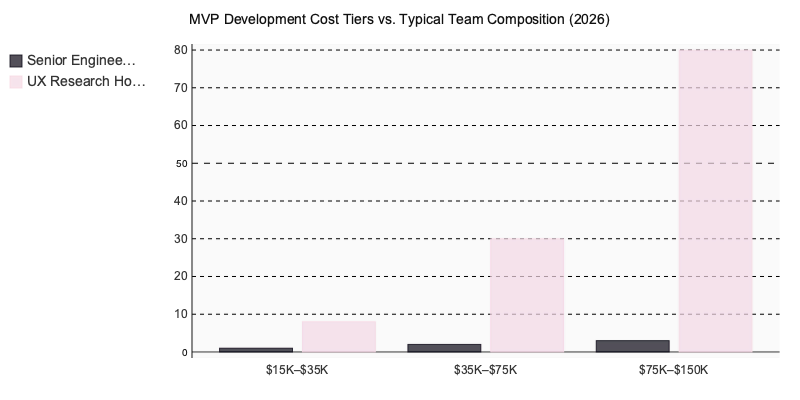
The lowest tier typically means a junior team, minimal discovery, and a fixed-scope contract that punishes you for learning anything new mid-build. The middle tier usually includes a dedicated UX researcher, senior full-stack engineers, and structured iteration cycles. The top tier adds product strategy, data infrastructure, and multi-platform capability.
Here’s what founders consistently get wrong: they optimize for day-rate instead of validated learning speed. Across 20+ vendor evaluations we’ve been involved in, founders who chose the cheapest option extended their total runway burn by two to four months through rework cycles. The “savings” evaporated in scope creep, miscommunication, and rebuilds after usability testing revealed fundamental navigation problems that a proper discovery sprint would have caught in week two.
Use a Paid Discovery Sprint as a Commitment Filter
Before signing a six-figure contract, invest $3,000–$8,000 in a paid discovery sprint with your top two candidates. A two-week sprint reveals what no pitch deck can: how the team communicates under ambiguity, whether their UX researcher actually talks to users or just runs competitor audits, and how fast they move from insight to prototype.
This isn’t a negotiation tactic — it’s risk management. You’re buying information about the working relationship before locking in.
MyPlanet Design — Delivers high-fidelity Figma prototypes validated through structured user research before any development begins, reducing downstream rework in early-stage SaaS builds.
Green Flags Vs. Red Flags: a Quick Vetting Guide
What to look for when narrowing your shortlist:
- Green flag: They ask about your target users before your feature list
- Green flag: Their contract includes a defined post-launch support window (minimum 30 days)
- Green flag: They show you a documented sprint cadence with client-facing demos every 1–2 weeks
- Red flag: They quote a fixed price without a discovery phase
- Red flag: No dedicated UX/UI designer on the proposed team
- Red flag: Case studies lack any mention of user testing or business metrics
The vendor you choose for v1 shapes your product’s trajectory for the next 12–18 months. Treat the selection process with the same rigor you’d apply to hiring a co-founder — because in every way that matters during the MVP phase, that’s exactly what they are.
The SaaS MVP Development Process: Stage by Stage
A credible minimum viable product development company follows a predictable sequence — not because creativity demands rigidity, but because skipping stages is how MVPs ship features nobody wants. Here’s the process broken into five stages with realistic timelines based on what we’ve observed across dozens of engagements.

The Five Stages
- Discovery (1–2 weeks) — Problem validation, stakeholder interviews, competitive audit, and assumption mapping. The output is a prioritized hypothesis list, not a feature backlog.
- UX Research and Wireframes (2–3 weeks) — User interviews, journey mapping, information architecture, and low-fidelity wireframes. This is where 60% of bad product decisions get killed.
- Design Sprint and Prototype (1 week) — High-fidelity clickable prototype tested with 5–8 target users. One concentrated week forces decisions that committees would debate for months.
- Development Sprints (4–8 weeks) — Iterative build in 1–2 week cycles, starting with the walking skeleton (more on this below).
- Beta Launch and Feedback Loop (ongoing) — Controlled release to 30–100 pilot users with structured feedback collection and rapid iteration.
Each stage gates the next. Discovery informs UX research targets. Wireframes feed the design sprint. The prototype validates what gets built. Skipping discovery to “move fast” is how teams spend eight weeks building the wrong thing at full speed.
The Walking Skeleton Pattern
Expert MVP firms don’t build feature-by-feature in isolation. They use what Martin Fowler calls a walking skeleton — a tiny implementation that performs a small end-to-end function, linking together the main architectural components. Think of it as proving your database, API layer, authentication, and frontend talk to each other before you build any real features on top.
Why does this matter for your vendor evaluation? Because firms that start with a walking skeleton catch integration failures in week one of development, not week six. Ask any shortlisted company: “What do you ship in your first sprint?” If the answer is a single isolated feature rather than a thin vertical slice through the entire stack, that’s a process maturity signal worth noting.
Tools That Signal Process Maturity
The toolchain a firm uses reveals how they actually work:
| Stage | Tools | What It Signals |
|---|---|---|
| Discovery | Notion, Confluence, Miro | Structured documentation culture |
| UX/Design | Figma, Maze | Research-driven design decisions |
| Sprint Management | Linear, Jira | Transparent progress tracking |
| Post-Launch Analytics | Mixpanel, Amplitude | Data-informed iteration |
| Feedback Collection | Intercom, Canny | Systematic user input loops |
When a firm can’t name their analytics stack during a discovery call, they’re not measuring outcomes after launch. That’s a red flag for any SaaS product where retention is the metric that matters.
What Structured Discovery Actually Prevents
One engagement we led involved a B2B logistics startup convinced they needed a real-time fleet tracking dashboard as their core feature. During discovery — specifically during structured user interviews with 12 dispatchers — three foundational product assumptions collapsed. Dispatchers didn’t want real-time tracking. They wanted automated exception alerts when shipments deviated from expected routes. The entire feature priority list was restructured before development began.
The result: an 8-week build focused on alert logic and route deviation detection. Fifty pilot users at beta launch. Seventy-eight percent 30-day retention — exceptional for a v1 product in logistics SaaS.
According to First Round Capital’s research, startups that conduct structured customer interviews during their earliest stages are significantly more likely to achieve product-market fit, with founders who talk to users before building reporting higher confidence in their roadmap decisions (First Round Review).
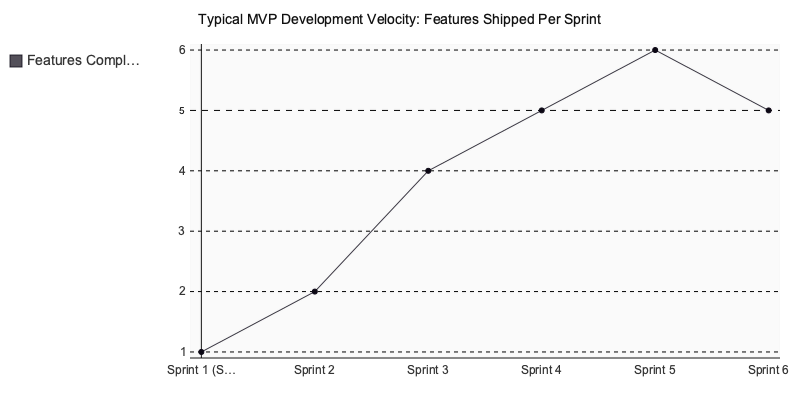
Notice the dip in Sprint 6 — that’s not a team slowing down. It’s the beta feedback loop kicking in, where iteration on existing features replaces net-new development. Any firm promising linear acceleration through an MVP build either hasn’t shipped many products or isn’t accounting for user feedback integration.
The stage-by-stage process isn’t just project management theater. It’s the mechanism that prevents the most expensive mistake in early-stage SaaS: building precisely the wrong product, efficiently.
Cost, Timeline, and Team Structure: What to Budget for Your MVP
SaaS MVPs in 2026 range from $8,000 to $200,000+ depending on three variables: who builds it, what’s included, and how fast you need to ship. Here’s the honest breakdown by vendor tier.
| Feature | Solo Freelancer / Micro-Agency ($8K–$20K) | Boutique MVP Studio ($25K–$80K) | Mid-Size Product Agency ($80K–$200K) |
|---|---|---|---|
| Discovery & Strategy | Rarely included | Included (1–2 weeks) | Full research sprint (3–4 weeks) |
| UX/UI Design | Template-based or minimal | Custom design, basic system | Design system with component library |
| QA & Testing | Developer self-tests | Dedicated QA pass pre-launch | Continuous QA with automated testing |
| Post-Launch Support | Typically none | 30–60 day warranty | Ongoing retainer options |
These tiers align with Clutch’s 2024 software development pricing survey, which aggregated rates across 1,000+ agencies globally.
How Long Should an MVP Take?
The median SaaS MVP takes three to six months from kickoff to beta. Four variables compress or extend that window: total feature scope, number of third-party integrations (payment gateways, CRMs, analytics platforms), design iteration rounds, and how quickly you as the founder close feedback loops. We’ve seen timelines balloon by eight weeks purely because a founding team took 10 days to approve wireframes at every gate.
The Minimum Team That Protects Quality
A credible minimum viable product development company staffs MVP engagements with at least five roles:
- Product manager — owns scope, priorities, and stakeholder alignment
- 1–2 UX/UI designers — handles research, wireframes, and high-fidelity prototypes
- 2–3 full-stack engineers — builds frontend, backend, and API integrations
- 1 QA specialist — catches edge cases before real users do
Drop below this configuration and risk compounds fast. Without a dedicated PM, scope creep goes unchecked. Without QA, your beta users become your test suite — and they don’t file bug reports, they just churn.
If budget forces a leaner team, cut design iterations rather than QA coverage. Ship with fewer screens, not fewer safeguards. A four-screen product that works flawlessly teaches you more than a twelve-screen product full of broken states.
Red Flags and Green Flags When Vetting an MVP Development Partner
The fastest way to disqualify an MVP vendor? Look at what’s missing from the proposal, not what’s in it. After sitting through dozens of vendor pitches, we’ve found the omissions tell you more than the sales deck ever will.
Red Flags
- No discovery phase in the project scope. If the proposal jumps straight from kickoff to wireframes, your assumptions will be baked into production code untested. That’s expensive validation.
- Fixed-price contract with no change management clause. MVPs are learning machines — the whole point is to pivot when data contradicts your hypothesis. A rigid contract penalizes the iteration that makes an MVP worth building.
- Offshore team with no product manager available during your business hours. A 9-hour timezone gap doesn’t kill a project immediately. It creates communication debt that compounds sprint over sprint until decisions stall.
- Portfolio shows only UI screenshots with zero outcome data. No retention numbers, no conversion metrics, no mention of what happened after launch. You’re looking at a design portfolio, not evidence of validated learning.
Green Flags
- Proposes user interviews and a competitor audit before any design work begins. This signals a team that treats discovery as a deliverable, not a checkbox.
- References specific architectural trade-offs made for a past client — for instance, choosing a monolith over microservices because speed-to-validation mattered more than theoretical scalability.
- Offers a structured paid discovery sprint as a standalone first engagement. This is the single strongest trust signal. It means the firm is confident enough to let you evaluate them before committing to a full build.
- Case studies include post-launch iteration and pivot decisions, not just the initial release. Any minimum viable product development company worth hiring stays involved past deploy.
Michael Seibel, Managing Director at Y Combinator, has repeatedly emphasized in Startup School lectures that the best technical partners push back on your feature list before writing a single line of code. We’ve seen this firsthand — the firms that challenge scope during discovery consistently deliver tighter, more testable products.
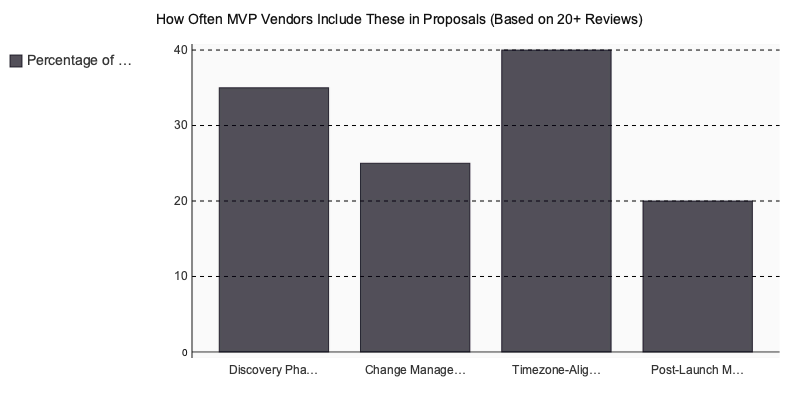
If a vendor checks all four green flags, they’re rare. If they trigger even two red flags, walk away — no matter how polished the pitch.
Your MVP Vendor Decision is a Product Decision — Treat it Like One
Choosing a minimum viable product development company isn’t a procurement exercise. It’s the first product decision you’ll make, and it compounds — the wrong partner doesn’t just cost money, it costs the months you can’t get back when your market window shifts.
Score vendors against the five criteria we covered: SaaS portfolio depth, UX research capability, tech stack fit, post-launch support, and pricing transparency. Audit their case studies for retention metrics, not visual polish. Demand a fixed-scope discovery phase before committing to a full build. And walk away from any firm that can’t articulate how they’ll help you stop building features, not start.
The founders who get v1 right aren’t the ones with the biggest budgets. They’re the ones who treated vendor selection with the same rigor they’d apply to hiring a co-founder. Your MVP partner will shape your architecture, your user experience, and your burn rate for the next 12 months.
If you’re early in that search, MyPlanet Design is worth a conversation — particularly for teams that want design-driven development with a structured discovery process.
Written by Nazar Verhun, CEO & Lead Designer at MyPlanet Design.
Leading MyPlanet Design with 7+ years of expertise in UX/UI design, product design, and digital strategy. Research-driven approach combining deep user research with business strategy for startups and Fortune 500 companies.
Frequently Asked Questions
What does a minimum viable product development company do?
An MVP development company helps startups validate their business idea by building the simplest functional version of their product. They typically handle product discovery, user research, prototyping, and delivering a launch-ready build scoped to only the features needed to test market fit.
How much does it cost to hire an MVP development company?
MVP development costs typically range from $15,000 to over $250,000, depending on the agency’s location, the complexity of your tech stack, and the firm’s tier. Regional pricing differences are significant, with Eastern European and Asian agencies generally charging less than US or Western European firms.
How do I choose between an MVP development agency and a freelance developer?
A specialized MVP agency offers structured processes like discovery phases, sprint cycles, and post-launch support that freelancers usually can’t match. Freelancers may cost less upfront, but agencies provide team continuity, established deployment practices, and accountability structures that reduce the risk of needing a costly rebuild later.
What are red flags when hiring an MVP development company?
The biggest warning sign is an agency that agrees to every feature request without pushing back on scope, as this often leads to bloated, unshippable products. Other red flags include lack of test coverage in their past work, no transparent development process, and an unwillingness to connect you with former clients who had difficult experiences.
How long does it take an MVP development company to build a product?
Most professional MVP builds follow a structured timeline of roughly 6 to 10 weeks, starting with a 2-week discovery phase followed by 2 to 4 weeks of prototyping and development. However, timelines vary based on product complexity, and founders should be wary of firms promising delivery in under a month for anything beyond a simple prototype.
Should I do a paid discovery phase before signing a full MVP development contract?
Yes, staging your engagement is strongly recommended. Starting with a paid discovery sprint lets you evaluate the agency’s communication, technical thinking, and cultural fit before committing to a full build, significantly reducing the financial risk of choosing the wrong development partner.